Złoty Stok, formerly known by its German name Reichenstein, is one of the oldest and most interesting mining centers not only in the Kłodzko Land, but in all of Poland – it is the oldest mining settlement in the current territory of the country. From the 13th century, when the Wrocław prince Henry IV Probus granted the Cistercians the right to mine gold, for seven centuries this city was a city of gold – valuable ore was mined here, coins were minted here, the most famous people of the era worked here, including Wit Stwosz himself, one of the most outstanding sculptors of the Middle Ages. Today, Złoty Stok, rebuilt in global dimensions by gold and human dramas, attracts tourists looking for adventure – both on underground routes with the only underground waterfall in Poland, and to discover medieval mining culture in an authentic, restored settlement.
History of Gold in Złoty Stok – From the Middle Ages to Decline
Oldest Traces – From the 10th Century
The history of gold in Złoty Stok goes far back into the past – there may already be traces of mining from the 10th century. These first miners, whose names we will never know, learned from each other how to find gold, how to mine it, how to purify it. These were empirical knowledge, passed down from generation to generation.
1273 – Formal Beginning of Documented History
However, the first certain documentary date is 1273, when the Wrocław and Kraków prince Henry IV Probus issued a privilege that granted the Cistercians from the monastery in Kamieniec Ząbkowicki the right to conduct mining operations in the area that was to become Złoty Stok.
Why did Henryk IV Probus choose the Cistercians? Because the order of monks from Kamieniec had capital, experience, and – most importantly – the administrative order necessary to conduct advanced mining operations. The Cistercians were like monks, but in fact they were talented managers and businessmen of the Middle Ages.
1334 – A City That Never Fell
In 1334, Złoty Stok officially received city status. It is not known exactly when it actually obtained city rights – documents indicate that it must have functioned as a city between 1273 and 1334, but the formal princely decision camejust in 1334.
1344 – Free Mining Town – Status of Trade Elite
Ten years later, in 1344, Złoty Stok received the status of a free mining town. What did that mean?
The status of a “free mining town” was one of the most valuable feudal privileges:
Tax Exemption: Miners and residents were exempt from ordinary taxes.
No Entry and Exit Fees: There was no need to pay fees for the right to enter and leave the city.
Mining Self-Government: The city was governed by a mining self-government, not directly by the voivode or prince.
Privilege of Choosing Craftsmen: Anyone who wanted to settle in the city and work in mining could do so without prior permission.
It was a system that attracted people from all over Europe – if you were a miner, carpenter, smelter, merchant associated with mining, you could come to Złoty Stok and start a new life without the burdens of feudal obligations.
1491 – Coat of Arms, Banner and Right of Mining Freedom
After decades of prosperity, in 1491, Złoty Stok was formally confirmed as a center of European importance. The city received a coat of arms, banner and the right of mining freedom. It was not a purely ceremonial thing – it was an official document that legitimized the city’s position among Silesian and European cities.
16th Century – Apogee and Dominance – 8% of European Gold
However, the real boom came only in the 16th century. It was the golden age of Złoty Stok – and this is not just a metaphor.
In the 16th century, Złoty Stok extracted about 8% of all European gold. Imagine that – just one town in the Sudetes, and it produces almost 1/12 of all the gold that the whole of Europe extracts!
What did this mean in practice?
Almost 200 Mines operated in the area of Złoty Stok and its surroundings
Specialized Smelters smelting gold
Own Princely Mint – from 1507 golden ducats were minted here
European Trading Companies – the Fuggers, the Thurzos, the Welsers, the Imhoffs – the elite of European business – invested in Złoty Stok
The city attracted merchants, artists, and ambitious people from all over Europe. It must have been lively, thriving, and full of energy.
1507–1514 Years – The Fuggers Take Control
In 1511, as a result of repaying a loan granted to the indebted Dukes of Ziębice, the Złoty Stok mines fell into the hands of the Fugger family from Augsburg. The Fuggers were the European financial elite – bankers, royal treasurers, political advisors.
Jakob Fugger, known as “Jakob the Rich”, took control of the mine. In 1513–1514 he built a new smelter (furnace for smelting gold) and obtained the exclusive right to trade. Controlling the gold of Złoty Stok meant controlling a significant part of European gold trade.
In 1566, the Fuggers combined their capital with the Hungarian Thurzo family and controlled the entire Silesian gold trade.
1565 – Tragedy at the “Golden Donkey” Shaft
However, not everything was gold. In 1565, a tragedy occurred that changed the fate of the city. In the “Golden Donkey” shaft, 59 miners died.
The collapse was never cleared, and the remains of the victims were never found. It was a disaster – almost 60 people, fathers of families, brothers, sons – died in darkness underground, leaving widows and orphans.
This tragedy was the beginning of a bad streak for the Fuggers. Their investment in Złoty Stok began to lose its profitability. The Fugger company soon withdrew from further involvement in the mine.
The Legend of Veit Stoss – An Artist Who Lost Everything
One of the greatest dramas associated with Złoty Stok is the story of Veit Stoss – one of the greatest sculptors of the Middle Ages and Renaissance. His story is a tragic tale of ambition, hope, disappointment, and career destruction.
Veit Stoss – A Krakow Genius
Veit Stoss (c. 1445–1533) was a Krakow sculptor, one of the most outstanding artists of his era. His works – especially the St. Mary’s Altar in Krakow – are considered masterpieces of Gothic art. The wooden altar with its intricate architecture and magnificent sculptures of saints occupies the entire wall of St. Mary’s Church and is one of the symbols of Gothic beauty.
For creating this monumental work of art, Stoss received a gigantic fee. It was money that could change his life – allowing him to retire from work, invest in real estate, and help his family.
The Furerks and the Promise of Wealth
<p class="my-2 [&+p]:mt-4 [&_strong:has(+br)]:inline-block
However, ambition pushed Stwosz further. He met the Fugger family – European bankers and magnates. The Fuggers offered him a business investment: to buy shares in the Złoty Stok Mining Partnership (mine).
The promise was tempting – the money from the altarpiece fee was to be doubled, or even tripled thanks to the results of the mine, which extracted gold and was known throughout Europe. The Fuggers were well known – they were bankers, servicing royal treasuries. If the Fuggers said that gold from Złoty Stok would be profitable – surely it had to be true.
Veit Stoss agreed. He invested all his money from the altarpiece fee in the Gold Mine in Złoty Stok.
Investment Collapse – Depleting Deposits
However, fate had other plans. The uranium deposits in Złoty Stok turned out – contrary to optimistic forecasts – to be rapidly depleting. What was supposed to be a safe investment turned out to be a failure. The mine began to extract less and less gold, while labor costs remained the same.
Veit Stoss looked around and realized – he had lost his entire fortune. His money from the St. Mary’s altar – money that was supposed to protect his future – disappeared into the depleted mines.
Forgery of a Bill of Exchange – Desperation
In desperation, he decided to forge a bill of exchange. It was a crime – a serious crime – but Stwosz was out of options. He needed money to pay off debts, to stay alive.
However, his plan failed. He was caught.
Trial in Nuremberg – Public Stigmatization
The trial took place in Nuremberg – in another city, which showed how seriously the matter was being treated. The court found him guilty of forgery.
The punishment was harsh and public – the artist was held in a dungeon and publicly branded on both cheeks and temples. It was branding with iron heated live – leaving permanent marks. Anyone who met Veit Stoss on the street would see these scars and know – this is a forger, this is a criminal.
Second Act – Return to Work
However, Stwosz’s genius was too great to be completely destroyed. After leaving prison, he returned to work. He created some new works of art, but never regained his former fame and position.
The legend of Veit Stoss shows how fragile the fate of even a genius can be – how one bad investment, one mistake can ruin a life.
The Fuggers and Columbus – Gold from Złoty Stok Finances the Discovery of America
Interestingly, the gold mined in Złoty Stok was directly involved in financing Christopher Columbus’s expedition. How did this happen?
Princess Isabella of Castile, the mother of Princess Joanna – who was to become Queen of Aragon – needed money to support Columbus’s expedition (1492). It was a crazy investment – almost no one believed that Columbus would find a new world. But Isabella was fullvision.
Where could she find the money? From the Fuggers – European bankers! And where did the Fuggers get their money? From the gold mined in Złoty Stok! Therefore, it can be said that Polish ore from the Sudetes helped finance the discovery of America.
This is one of those strange twists of history – unknown miners from Złoty Stok, without knowing it, worked on a world-changing expedition.
Gold Mine – A Modern Tourist Attraction
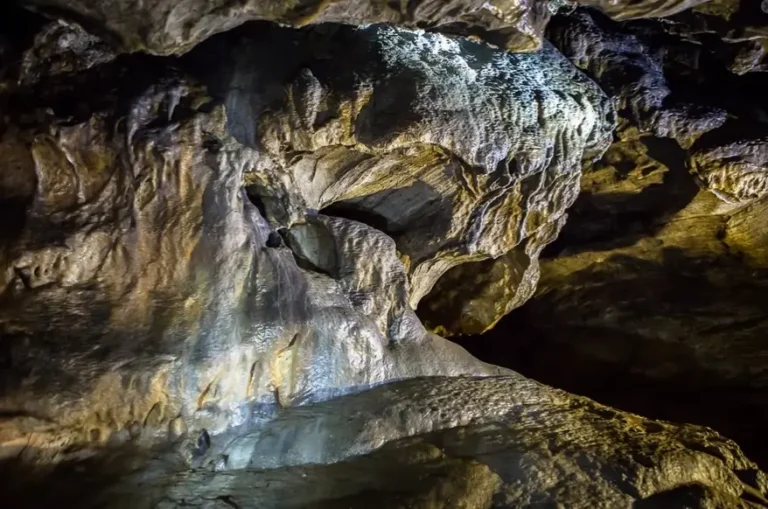
Today, the Gold Mine in Złoty Stok is one of the most attractive places in Lower Silesia. In 1996, two adits were selected from the huge labyrinth of 320 kilometers of underground tunnels for tourist visits.
“Gertruda” Adit – An Underground Boat Ride
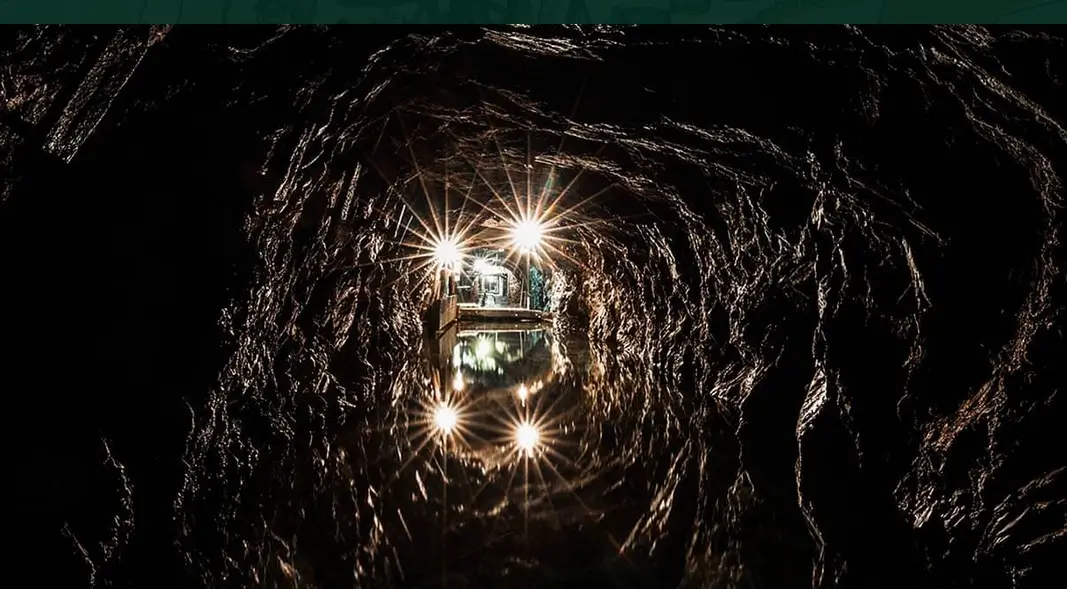
“Gertruda” Adit is the main sightseeing route. On a section of the tunnels, about 200 meters, you can travel on a 15-person boat called “Titanic”. It was fun – a ride on an underground lake, which was created by flooding old excavations with groundwater.
It is also possible to:
Gold Panning – every tourist has a chance to find real gold grains
Striking Gold Ducats – replicas of medieval coins
Viewing Gold Bar Castings – a demonstration of traditional techniques
Czarna Adit – The Only Underground Waterfall in Poland
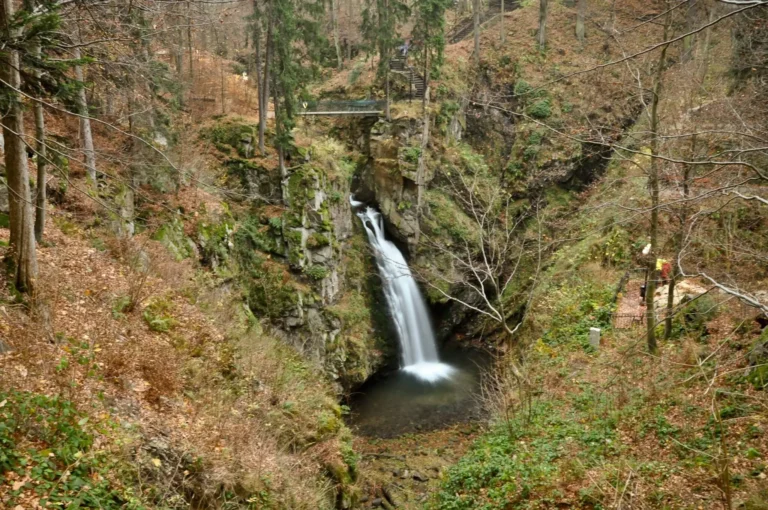
But the main attraction is the Czarna Adit, which contains the only underground waterfall in Poland.
Characteristics of the Underground Waterfall:
Fall Height: Approximately 8 meters (some sources say 10 meters)
Location: 23 meters below the surface
Lighting: Beautifully lit, creating an amazing atmosphere
Access: Down seven floors via metal stairs, then through a carved-out passage
Effect: Water falls with a crash, sometimes splashing the faces of visitors
The return from the Black Adit is done by the Orange Tram – a small train that slowly pulls tourists back to the surface.
Practical Information – Visiting
Entries: Every 45 minutes
Visiting Time: About 1.5 hours
Reservation: Not required
Temperature in the Mine: Approx. 10–12°C – it’s worth taking a jacket
Ticket Prices:
Regular ticket: 53 PLN
Reduced ticket (students, pensioners): 43 PLN
Golden ticket (3 main attractions): 83 PLN regular, 63 PLN reduced
Children up to 4 years: free
Medieval Mining Settlement – Technology Park
Right next to the Gold Mine operates the Medieval Mining Settlement – Technology Park. This is a unique attraction – an accurate replica of a medieval mining village.
Devices on a 1:1 Scale
All devices were built on a 1:1 scale (i.e., real size) based on medieval engravings by Georgius Agricola – the famous Renaissance work “De re metallica” (On Mining).
Among the devices are:
15-Meter Horse Gin – a large wheel for pulling miners and ore from the shaft
- <p
3-Ton Treadwheel – powered by feet, for pumping water
Metal Presses – for breaking ore
Smelting Furnaces – for melting ore into pure metal
All the devices work – they are not dead exhibits, but functional machines that show how medieval miners worked.
Executioner’s Hut and Underground Tunnel of Secrets
An additional attraction is the Executioner’s Hut – of a medieval executioner, who played an important role in mining societies. The executioner punished miners who stole gold – the punishment was public and severe.
The Executioner’s Hut is accessed via an underground tunnel full of secrets and fears – with light and sound effects that create an atmosphere of medieval fear.
Replica of Leonardo da Vinci’s Tank
On the site of the Settlement, there is also a replica of the tank invented by Leonardo da Vinci – a visionary war machine that was never built in the Middle Ages, but whose plans have survived. Tourists can ride this device.
Significance of the Settlement
This is the only replica of a medieval mining village in Europe that is so accurate and rich in equipment. It has educational value – it allows tourists to physically experience how miners worked, what tools they used, how hard their work was.
History of the City Since 1945 – Change of Name and Troubles
May 8, 1945 – Occupation by the Soviets
On May 8, 1945, just a day after Germany’s surrender, Złoty Stok (then still known as Reichenstein) was occupied without a fight by the Soviet army. The city went from one regime to another almost immediately.
Expulsion of the German Population
The entire existing population of the city (mostly German) was expelled across the Oder River. This was a tragic episode – tens of thousands of people lost their homes and had to leave the areas where they had lived for generations.
Change of Name – From Reichenstein to Złoty Stok
The cityIt was first named "Równe", and the railway station in the Polish PKP nomenclature was named "Rychłowiec". These were temporary names, completely unrelated to the history and tradition of the city.
Only in May 1946, by ministerial decree, the Polish name "Złoty Stok" was introduced - referring to the Polish word for gold and the Polish term for a hillside slope.
Mine Closure – 1961
In 1961, the last mine in Złoty Stok was closed. The last ore mined was arsenic (used in the production of pesticides and rat poison), not gold. The golden age was already in the past.
Numbers – 700 Years of Extraction and 16 Tons of Pure Gold
It is estimated that during 700 years of exploitation (from the 13th to the 20th century), approximately 16 tons of pure gold were extracted from local deposits.
16 tons is less than it might seem - but this is gold of the highest purity, the things that went to royal coffers, to the jewelry of the aristocracy, to the decorations of churches and palaces.