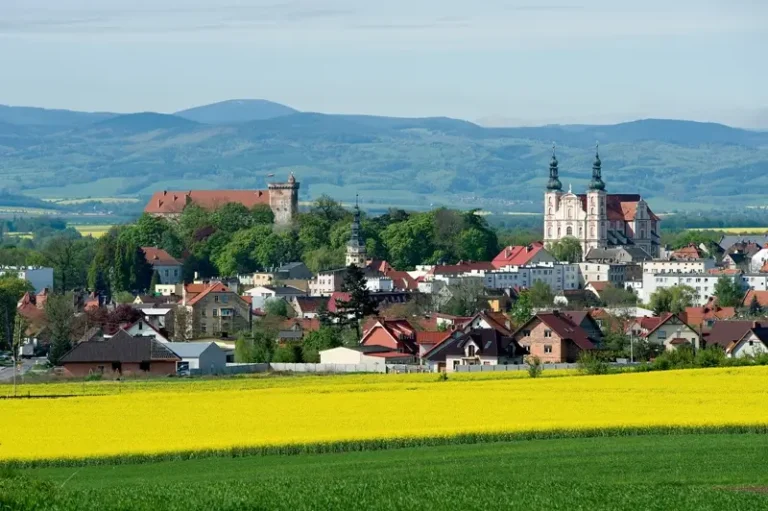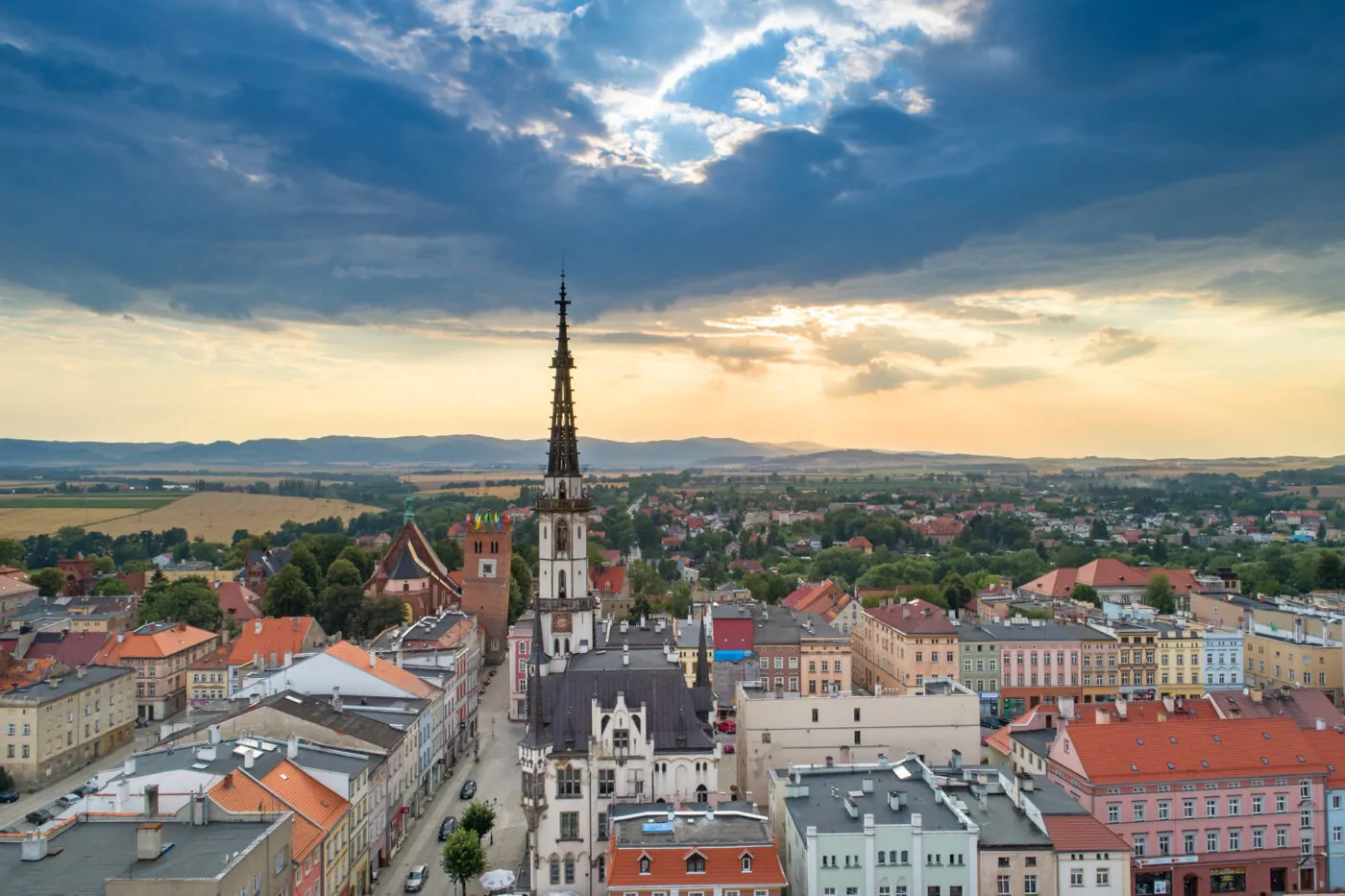
Ząbkowice Śląskie is one of the oldest cities in Silesia, located at the intersection of important trade routes – but today it is mainly known for one extraordinary monument: the Leaning Tower, which is the second most leaning tower in Europe, right after the famous Leaning Tower of Pisa in Italy. This 34-meter Gothic belfry leans at an angle of as much as 2.14 meters from the vertical – and, most strangely, its lean is still increasing every year. The history of its leaning dates back to August 24, 1598, when the tower tilted by 1.5 meters in one night – an event that petrified the city’s residents and sparked speculation about the causes for centuries to come. Scientists are debating – whether it was caused by tectonic tremors in Bardo in 1590, the ground becoming waterlogged and the foundations settling, or perhaps – as the legend says – the builder built it leaning on purpose, even signing his name on the wall with the words “Ich heiß Johannes Gleiß, hab diesen Turm schieff gebaut mit Fleiß” (“I am Johannes Gleiß, I built this tower crooked with care”)?.
History – From the Middle Ages to the Most Dynamic Development of the 19th Century
1280 – The Beginnings of the City and Frankenstein
The history of Ząbkowice Śląskie does not have a precisely established date of establishment, but indirect accounts indicate that the city was founded around 1280.
The oldest document in which the city is mentioned as “civitas Frankenstein” (i.e. “Frankenstein’s City”) is dated January 10, 1287.
The name “Frankenstein” came from the knight Theodor von Frankenstein, who was a powerful landowner in this region.
13th–14th Centuries – Fortifications and Development
The first fortifications the city received were of the wood and earth type – simple protective palisades.
These first fortifications existed until the 1330s, when they were replaced by a stone wall – a more advanced defense system.
Natural fortification:
The city had an excellent defensive location – it was located in an area with steep slopes, surrounded by wetlands and the backwaters of the Budzówka and Węża rivers.
However, from the north, where the city bordered Wrocław, the city had no natural protection – there it was necessary to rely on man-made fortifications.
14th–15th Centuries – Reconstruction and Renaissance
In the 15th century, Ząbkowice underwent a transformation in the Renaissance style.
Károly I Podiebrad (Duke of Ząbkowice in the 16th century) built a Renaissance castle – the first Renaissance defensive building with a regular, rectangular plan in Silesia.
This testifies to the city’s wealth and seriousness.
1598 – Crisis: Great Fire and Tower Tilt
August 24, 1598roku one of the greatest misfortunes in the history of the city occurred – the tower tilted by 1.5 meters.
What happened?
It is not known exactly – there are several theories:
Tectonic Tremors: These may have been caused by tectonic tremors, which were recorded on September 15, 1590 in nearby Bardo. These tremors may have weakened the stability of the structure
Soil Soaking: The cause may have been soil soaking, which caused the foundation to subside – especially if there was a weak layer of clay under the foundation
Excessive Weight: Excessive weight of one side of the building – perhaps an additional load on the northeast side
Legend of Intentional Inclination: According to some legends, the tower may have been built intentionally inclined – as an architect’s fantasy. In the 19th century, when the tower was partially destroyed in a fire, an inscription was discovered inside: “Ich heiß Johannes Gleiß, hab diesen Turm schieff gebaut mit Fleiß” – which in Latin translates to “I am Johannes Gleiß, I built this tower skewed with diligence”
1858 – The Great Fire of the City and Destruction of the Tower
In 1858 the entire Ząbkowice was hit by a great fire disaster.
The tower was significantly damaged, especially in the top part.
The Prussian authorities even intended to dismantle it – considering it dangerous and useless.
However, fortunately, it was decided to renovate it.
After reconstruction:
Tower height: Reached 34 meters
Top: Received a top in the shape of “dovetail joints” (characteristic of the Renaissance)
Additional Turret: A small turret with a spiral staircase was added on the south side – which made it easier to get to the top
20th and 21st Centuries – Dynamic Development and Contemporary Challenges
In the second half of the 19th century and at the beginning of the 20th
of the age saw the most dynamic development of Ząbkowice in history.
In the city center, many new tenement houses were built, replacing the dwellings consumed by fire.
New hospitals and schools were built, e.g. primary school no. 1 and middle school no. 2.
The city was modernizing, taking on the features of a modern European town.
2018 – Closure for Renovation
In 2018, the Leaning Tower was closed to tourists due to the structural condition.
Reason for closure:
Settlement of the extension – a small turret with stairs, adjacent to the tower.
Cracks and fissures – appeared on the walls of the monument, visible for several years.
Variable ground and water conditions – and different foundation levels of the tower and the extension.
After three months of renovation, the tower was reopened to visitors.
Leaning Tower – Architecture and Characteristics
Dimensions and Inclination
Height: 34 meters – the highest leaning tower in Poland.
Deviation from Vertical: 2.14 meters (currently)
Historical Deviation: In 1977 it was 1.98 meters – which means that the inclination is increasing!
Number of Stairs: 139 steps lead to the top.
Comparison with the Leaning Tower of Pisa
The Tower in Ząbkowice is often compared to the Leaning Tower of Pisa in Italy:
Pisa: Height 56 meters, deviation approximately 3.97 meters – Pisa is taller and more tilted
Ząbkowice: Height 34 meters, deviation 2.14 meters – it is the second most leaning tower in Europe after Pisa
Function of the Tower
Originally: Belfry of the parish church of St. Anne
Currently: Viewpoint and main tourist attraction of the city
Views from the Top
From the top of the Leaning Tower you can admire the panorama of Ząbkowice Śląskie and the surrounding area – and from a special angle, because the tower is leaning, the perspective of the views is very unique.
History of the Tower’s Construction – 14th Century
14th Century – Construction of the Belfry
In the 14th century, when the city expanded after the city walls were moved, it was decided to rebuild the former defensive tower into a belfry of the parish church of St. Anne.
1413 – Completion of Construction
Probably in 1413, the construction of the belfry was completed.
It was a Gothic structure, solidly built with thick walls that testified to its previous defensive function.
Riddles and Legends – Why is the Tower Leaning?
Theory 1: Tectonic Shocks
The shocks of September 15, 1590 may have weakened the foundations and tilted the tower 8 years later.
Bardo, a nearby town, is known for its tectonic activity in the Middle Ages and modern times.
Theory 2: Foundation Settlement
Soaked ground could have caused uneven foundation settlement – one side sank more than the other.
This is the most scientifically justified theory.
Theory 3: Legend of Intentional Tilting
According to legend, the builder Johannes Gleiß intentionally built it leaning, signing himself with words inside the walls:
“Ich heiß Johannes Gleiß, hab diesen Turm schieff gebaut mit Fleiß”
Translation: “I am Johannes Gleiß, I built this tower crooked with
pielęgnacją/z zamiarem”
This legend suggests that it could have been the artistic or humorous intention of the architect.
Fact: The Tilt Is Still Increasing
Modern geodetic measurements confirm that the tilt is increasing year by year.
In 1977 it was 1.98 meters, and now it is already 2.14 meters – an increase of 0.16 meters in about 40 years.
If this trend continues, the tilt may approach 3 meters in 200 years.