The Uranium Mine in Kletno is one of the most mysterious and dramatic places in the entire Kłodzko Land – an underground fortress, where during the peak of the Cold War, the Soviet Union, using Polish hands, extracted raw material for the construction of the atomic bomb. Hidden in the mountains of the Śnieżnik Massif, near the picturesque village of Kletno, this mine is a living testimony to the geopolitical antagonisms of the second half of the 20th century – a time when the world was driven by rivalry between two superpowers, and no one hesitated to pursue atomic science and secret operations. Today, adit No. 18, the only part of this extensive complex of excavations accessible to tourists, attracts thousands of visitors every year who want to see, feel, and understand the history that was hidden from the world for decades.
History – From the Middle Ages to the Soviet Nuclear Race
Medieval Beginnings – Miners Seek Wealth
The history of minerals in the Kletno region dates back to the Middle Ages, when local miners and merchants began to penetrate the area in search of valuable ores. This was not tourism – it was a desperate game of survival and wealth.
In the Middle Ages, the following were mined here:
Iron Ores – the most valuable material for steelmaking, essential for weapons and tools
Silver – for the rich and churches, for coins and jewelry
Copper – for bronze and metallurgical projects
Fluorite – a mineral with special properties
In 1483, the first specific mentions of the mine trade appear in documents. Nicolas Bechman from Świdnica sold the mine in Kletno to a certain Boran. Such a detail in the documents shows that these were not accidental excavations – it was a serious economic operation.
17th and 18th Centuries – Exploitation Grows, Profitability Falls
For centuries, mining in Kletno flourished. In the 16th and 17thwieku działały tu liczne sztolnie z nazwami takimi jak „Sankt Paul” i „Sankt Jacob”. W 1606 roku istniała w Kletnie huta – świadek zaawansowanego poziomu obróbki minerałów.
However, with the end of the 17th century, the situation changed. Swedish troops during the Thirty Years’ War (1618–1648) devastated the entire Kłodzko Land, including the Kletno area. Despite attempts at reactivation, the economy based on the extraction of raw materials no longer brought such profits. At the end of the 17th century, mining and metallurgy in Kletno actually collapsed.
19th Century – From Ruin to Small Revival
In the 19th century, Kletno woke up, but not because of minerals – but because of tourism. The landscapes of Sudeten nature and mountain remoteness attracted more and more spa guests and tourists. In 1840, the village had 44 buildings, two mills, and three sawmills. Tourism began to displace mining.
1948 – Soviet Race for Atomic Power
However, the breakthrough came in the most unexpected times. In 1948, just three years after the end of World War II, when Europe was still healing from its wounds, a new game appeared on the horizon – the Cold War and the nuclear race.
Polish-Soviet Agreement:
On September 15, 1947, an agreement was signed between the government of the Polish People’s Republic (being in the Soviet sphere of influence) and the Soviet Union. This agreement allowed the Russians to conduct uranium ore searches throughout Poland.
Why did Poland agree to this? Because it had no choice – Poland was a satellite country of the USSR, and Stalin decided the fate of the country. Rebellion would have been tantamount to political and military disaster.
Soviet Specialists Analyze the Mountains:
The Russians, knowing the needs of their Soviet atomic experiment, carried out thorough geological analyses of the whole of Poland. Their scientists studied old maps, old documents, and the results of mineralogical research. They concentrated on the Sudetes – a region that was already famous in the Middle Ages for its wealth of ores.
July 1948 – A Fateful Discovery:
In July 1948, Soviet geologists, examining the old mine dumps in Kletno, made a breakthrough discovery. In an old adit called “Sankt Paweł” (later adit No. 7), they detected elevated gamma radiation and uranium mineralization.
They found uranium!
This was a discovery of strategic importance for the Soviets. Uranium is a rare element, and enriched uranium isotope U-235 is the key to building an atomic bomb. Stalin desperately needed this material – the United States had already dropped atomic bombs on Hiroshima and Nagasaki, and the Soviet Union had no uranium resources on its territory.
Secret Years 1948–1953 – Building Soviet Atomic Power
Code Name “Kopaliny” – Secret Operation
Immediately after the discovery of uranium, the Russians began to act. The mine was given a secret code name – “Kopaliny” (Minerals). This was an operation classified at the highest level of secrecy.
In official documents, the name “uranium” was avoided – instead, enigmatic codes were used:
“Metal” – instead of uranium
“R2”, “P-9” – various code names
“Non-ferrous Metals” – a general term
Transports to the USSR were described as “Waste Earth” – when in reality, the most valuable raw material was being transported.
Infrastructure – 37 Kilometers of Excavations
What the Russians achieved in Kletno is a testament to their determination. In just three years (1949–1952), the Soviets built a network of underground excavations of unimaginable scope:
37 Kilometers of Total Corridor Length
20 Adits (or 27 in some sources)
3 Shafts – Vertical Shelters Connecting Levels
9–10 Levels of Exploitation
These were engineering masterpieces – excavations carved into hard granite and metamorphic rocks. Each kilometer represented thousands of hours of miners’ work, each level required advanced planning and engineering.
Polish Labor Force – Prisoners, Soldiers, Forced Miners
However, behind this engineering greatness lay a human tragedy. The engineering staff was exclusively Soviet – the Russians wanted to control everything. But the workers – working in inhuman conditions – were Polish.
Among these Polish workers were:
Prisoners from Labor Camps – people imprisoned for “too much independent thinking”
Soldiers from Conscription – young people forced to serve in the mine
“Reactionaries” and “Enemies of the People” – terms used by communists
marked everyone who disagreed with the regime
Well-Paid Miners – a number of professional miners who came to Kletno from other regions of Poland
Working Conditions – Hell in the Underground
Working conditions in the mine were inhumane:
12 Hours of Work Daily – regardless of fatigue or health
Lack of Adequate Precautions – no care was taken to protect against radiation, no respirators were provided
Radiation Hazard – employees were exposed to radioactive radiation without proper safeguards
Low Wages – for most workers, especially prisoners, the work was forced labor
As a result, people working in the mine became seriously ill. Cases of cancer, cardiovascular damage, and health problems that developed years after leaving the mine were observed.
Extraction – Estimates and Numbers
In just five years (1948–1953), the Russians extracted from Kletno:
Approximately 3100 Tons of Uranium Ore
Approximately 20 Tons of Pure Uranium – after initial processing
120 Kilograms of Enriched Uranium – after further processing in Soviet facilities
It is estimated that this constituted about 5% of total Soviet extraction in the Sudetes.
Destination – Stalin’s Atomic Bomb
The destination of this uranium was clear – the construction of the Soviet atomic bomb. Stalin, competing with the United States in the Cold War nuclear race, desperately needed this material.
The first Soviet atomic bomb was detonated on August 29, 1949 – just a year after the discovery of uranium in Kletno. Polish uranium from the Sudetes contributed to the construction of this bomb – unknown to the Polish miners who toiled in the mine every day.
1953 – End of Secrecy
<p class="my-2 [&+p]:mt-4 [&_strong:has(+br)]:inline-block
In 1953, the Russians observed significant drops in production. The uranium deposit in Kletno was finished – it was no longer economically viable to continue mining. In March 1953, the Russians stopped the operation.
Poland took over the mine – but Poland didn’t know what to do with this radioactive legacy. For many years, the existence of the uranium mine was kept top secret.
Adit No. 18 – Currently the Only One Available to Tourists
Out of the entire extensive complex of 37 kilometers of excavations, today only adit no. 18 – a fragment on the north-eastern slope of Żmijowiec – is available for visiting.
Location and Access
Location: By the road connecting Kletno with Sienna
Entrance Height: 773 meters above sea level
Length of Available Excavations: Approximately 400 meters of corridors
Width of Corridors: 1.5–2 meters
Ceiling Height: 1.7 to over 2 meters – sometimes lower
Opening Hours and Visiting Rules
Open All Year Round: Daily from 9:00 AM to 5:00 PM
Guided Tours: Mandatory – a guide always leads the tourists
Groups: From a few to a dozen or so people (maximum up to 25 people)
Tour Duration: Approximately 45 minutes
Entries: At designated hours (usually every hour)
Admission Prices
Regular Ticket: 16–50 złoty (prices may vary depending on the source and current rates)
- Discount Ticket: 13–35 PLN (for students, pensioners, children)
Safety – No Radioactivity
Adit No. 18 is completely safe in terms of radioactive radiation. Modern measurements confirm that radioactivity levels are normal and do not pose a threat to tourists.
However, the interior of the mine has:
Constant Temperature of Approx. 6–7°C – you need to take a warm jacket
High Humidity – the air is very humid
Low Air Movement – stale, underground draft
What Can Be Seen
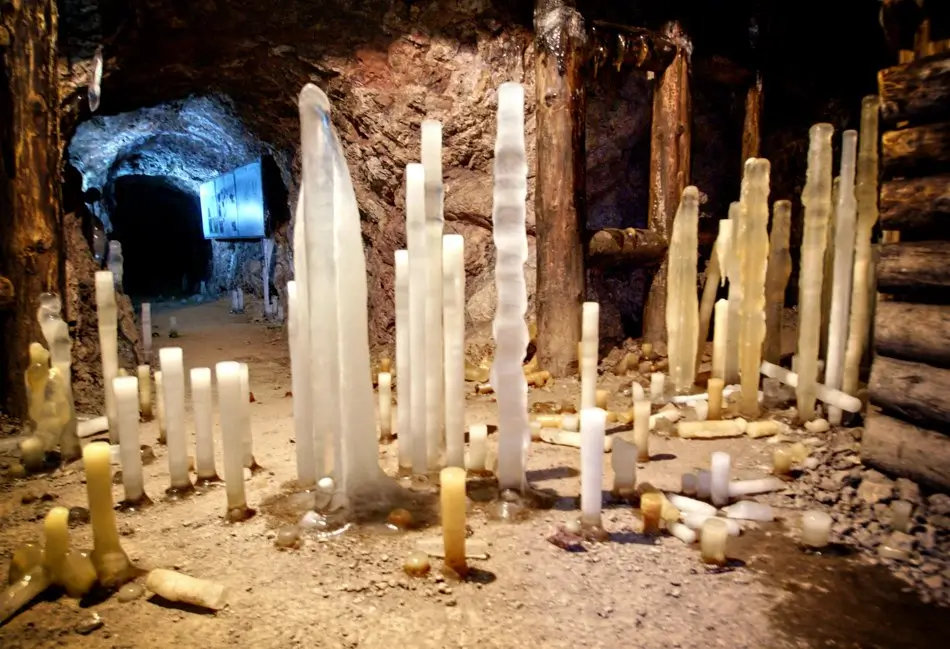
Spectacular views await tourists in Adit No. 18:
Minerals in Special Lighting:
Fluorite – a mineral in shades of purple, green and yellow, perfectly illuminated
Amethyst – a stunning purple variety of quartz
Quartz – various varieties, sometimes with an iridescent sheen
Other Minerals – iron, fluorite, pyrite and others
Historical Exhibits:
Collection of Mining Lamps: From oil lamps, through kerosene lamps, to carbide lamps – shows how miners worked in poor light
Old Mine Maps – documenting the system of workings
Mining Equipment – tools used by miners, sometimes from the 19th century
Green Uranium Glass – which glows in ultraviolet light
Uranium Nodule – genuine radioactive uranium, enclosed in a glass container
Geological Features:
Rock Stratification – showcasing geological evolution over millions of years
Damage Caused by Mining – a testament to human activity
Special Tour Options
In addition to the standard route, the mine offers:
Night Tour: By the light of lamps – for the more adventurous
3-Hour Terrain Quest: For children and families, full of educational games
Group Visits: With a special program for schools and business groups
The Mysterious Morawka Settlement – Housing for Mine Workers
A historical curiosity is the fact that for the needs of the mine in nearby Stronie Śląskie] a special residential settlement called Morawka was built. This shows the scale of the Soviet operation – they not only mined, but also built the entire infrastructure for the workers.
Morawka was a Soviet project – functional, standard, without luxuries. The families of mine workers lived there, especially engineering staff of Soviet origin.
Past and Present – From Secrecy to Tourism
What was once the most closely guarded secret now attracts tourists looking for adrenaline and history. The Uranium Mine in Kletno<button class="border-subtler group-active/language-learning:!bg-subtle inline-flex size-5 items-center justify-center rounded-full border shadow-sm outline-none border-subtlest ring-subtlest
] is a unique example of a place transformed – from a hell of forced labor and nuclear threat to an educational and tourist attraction.
Guides tell the bitter history – of prisoners of labor camps, of young soldiers forced to work, of the Soviet ambition to build atomic weapons. These are stories that humanize history – showing that behind the great politics stood people whose lives were changed by the decisions of the powers.