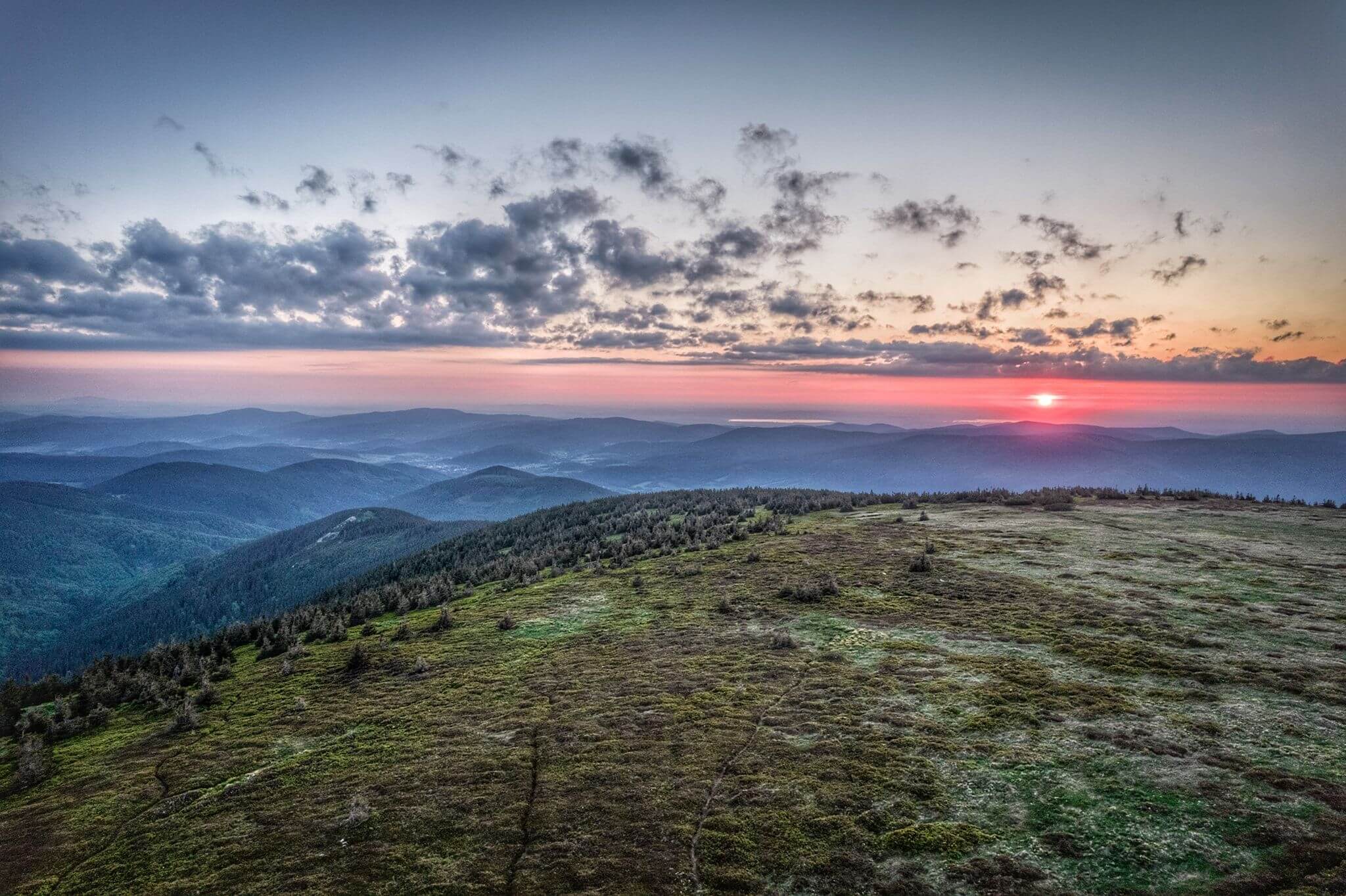
Sumatorie is one of the most hidden and underrated places in the Śnieżnik Massif – almost completely overlooked by tourists marching to Śnieżnik or the Bear Cave, yet offering excellent natural and landscape reflections for less conformist hikers. The name “Sumatorie” (or its variants) refers to specific areas in the middle of the Śnieżnik Massif – usually these are mountain meadows, i.e. natural, treeless mountain meadows, where endemic alpine flora grows, and the views reach almost to the sky. This is a place where tourist crowds rarely appear, where mountain silence is a reality, and every flower has its story to tell – from Carpathian garlic, through alpine snowdrops, to unique Sudeten endemics that you won’t find anywhere else in the world. The history of Sumatorie is the history of slow rebirth of nature after the era of intensive mountain grazing, the history of vegetation zones differentiated by several hundred meters of altitude, and for those who have eyes to see – it is an open atlas of nature written live.
Geography and Location – The Heart of the Śnieżnik Massif
Śnieżnik Massif – Geographical Context
Sumatorie are located within the Śnieżnik Massif, which is the second highest mountain range in the Eastern Sudetes.
Characteristics of the Massif:
Main Peak: Śnieżnik (1425 m above sea level), the second highest mountain in the Polish Sudetes
Area: Approximately 30 km long with a characteristic structure of four ranges spreading from the summit
Location: On the border between Poland and the Czech Republic, within the Śnieżnik Landscape Park
Surroundings: Kłodzko Valley to the north, Bialskie Mountains to the east, and Złote Mountains to the west
Where Exactly is Sumatorie?
Sumatorie is an area difficult to precisely mark on the map – it is not an officially marked place, but rather an informal, dispersed name of the area.
Generally, they are located:
On slopes and between passes – between the main peak and side ranges
In the subalpine/alpine zone – at an altitude of 1200–1400 m above sea level, where mountain pine and alpine grasslands dominate
Off the beaten path – to find Sumatoria, you have to deviate from the routes marked on maps
Little-Known Tourism – Why Do Tourists Avoid It?
Lack of Tourist Infrastructure
Unlike Śnieżnik (with its modern observation tower) or Niedźwiedzia Cave (with parking lots and guides), Sumatorie does not have any tourist infrastructure:
No Shelter: There is no typical mountain lodge for tourists here
No Parking: There are no special parking spaces for this area
No Guides: No one officially offers tours to Sumatoria
No Directional Signs: Trail marking is minimal
Information Inaccessibility
Most tourist guides and tourism applications do not list Sumatoria as a separate attraction.
Access to information requires deeper searches, consultation with local guides or older mountain enthusiasts who know hidden corners.
Sometimes “Forgotten” by Tourist Networks
Mass tourism focuses on the highest peaks (Śnieżnik), the most interesting caves (Niedźwiedzia), the edges accessible on foot (Trójmorski Wierch).
Sumatorie, on the other hand, are omitted – although geographically close, they are invisible from a tourist perspective.
Tourist Trails – How to Get to Sumatoria?
Trail 1: From Międzygórze Through Sumatorie to Śnieżnik
Characteristics:
Difficulty: ⭐⭐ (medium)
Length: 8–10 km one way
Time: 4–5 hours
Elevation Gain: 600–700 meters
Route Description:
Starting from Międzygórze, instead of following the main, red trail to Śnieżnik, we turn:
Phase 1 (0–2 km): Gentle ascent through beech and fir forest
Phase 2 (2–4 km): Entering the dwarf pine zone – plants become dwarfed, orientation becomes more difficult
Phase 3 (4–7 km): SUMATORIE – open alpine meadows, without clear trails, but nature is the guide
Phase 4 (7–10 km): Ascending to the main ridge, finally to Śnieżnik
Special Features:
Lack of clear markings – you need to orient yourself by the terrain
Spectacular views of the valleys
Endemic vegetation everywhere around
Silence – almost no one comes here
Trail 2: Sumatorie – Krąż Loop
Characteristics:
Difficulty: ⭐⭐⭐ (difficult – orientation)
Length: 6–8 km (loop)
Time: 4–5 hours
Elevation Gain: 400–500 meters
DescriptionTrasy:
This is a loop entirely within the Sumatoria zone, without going to the main peak of Śnieżnik:
Start from the pass or junction between trails
Going around between small peaks and saddles
Admiring alpine flora up close
Return through other slopes
Special:
For Advanced – requires good spatial orientation
No Other Tourist – you’ll be almost alone
Full of Nature – every step reveals something new
Views – What Will You See in Sumatorias?
Panorama of the Śnieżnik Massif
From Sumatoria you can enjoy 360-degree views:
Eastern Side: Bialskie Mountains, further Moravia
Western Side: Kłodzko Valley, Złote Mountains
Southern Side: Czech Śnieżnik Massif, Suszyny Mountains
Northern Side: Majestic peaks of the Jeseníky Mountains
Micro-landscapes
In Sumatoria you will discover tiny landscapes of gigantic value:
Tiny Wind Shields: Where the wind forms unusual shrub structures
-
<p class="my-2
Springs Flowing in Streams: Sources of tiny streams
Rocky Surroundings: Outcrops of granite emerging from the grass
Flowering Meadows: In season (July–August) full of blooming alpine plants
Alpine Flora – Living Lesson of Vegetation
Vegetation Zones of the Sudetes
Sumatorie are ideally located for observing vegetation zones of the Sudetes:
Lower Montane Zone (650–1200 m):
Beech forest with admixture of fir and spruce
Here, tourists usually wander without paying attention
Dwarf Pine Zone (1200–1400 m):
Mountain Pine (Pinus mugo) – the dominant of this zone
Gradually dwarfing and breaking into fragments
Between them grow small shrubs (blueberries, dwarf juniper, heather)
Alpine Zone (Hale, 1400+ m):
Alpine Meadows – natural mountain meadows
Grasses: Lawns specific to the alpine
Flowering Herbs: Endemics that only grow here
Sudetic Endemics – Rare Species
Only in Sumatorie (and a few other places in the Sudetes) grow:
Victory Onion (Allium victorialis) – a Carpathian-Sudetic endemic
Krain’s Scopolia (Scopolia carniolica) – endangered species
Stemless Carline Thistle (Carlina acaulis) – a mountain plant with tiny, violet flowers
Edelweiss (Leontopodium nivale) – the most emblematic alpine plant
Alpine Fauna
Besides plants, Sumatorie is inhabited by:
Marmots – sometimes
Eagles and Hawks – soar high
Alpine Salamanders – in damp places
Mountain Butterflies – colorful, fast, elusive
Practical Information
How to get there?
Starting Base: Międzygórze (shortest), Kletna, Czarna Góra
Parking: Parking in Międzygórze (~15 PLN/day)
Public Transport: Bus from Kłodzko to Międzygórze
Essential Equipment
Detailed Map: Paper map (GPS may fail in areas without coverage)
Compass: Manual orientation essential
Water: Minimum 2–3 liters – no springs here
Food: Provisions – no bar here
Layered Clothing: Weather conditions change quickly
Camera: Alpine vegetation is beautiful
Safety
Never Go Alone – if you get lost, there will be a problem
Avoid Storms – the Summatories are very prone to lightning strikes
Seek Information Locally – you can find experienced hikers in Międzygórze
Inform Someone – where you are going, when you will return
Best Time to Visit
July–August: Peak Season – flowers, warmth, long days
June: Still a time of bloom, but cooler
September: Golden Autumn – few tourists, beautiful colors
Winter: Possible, but requires experience and winter equipment