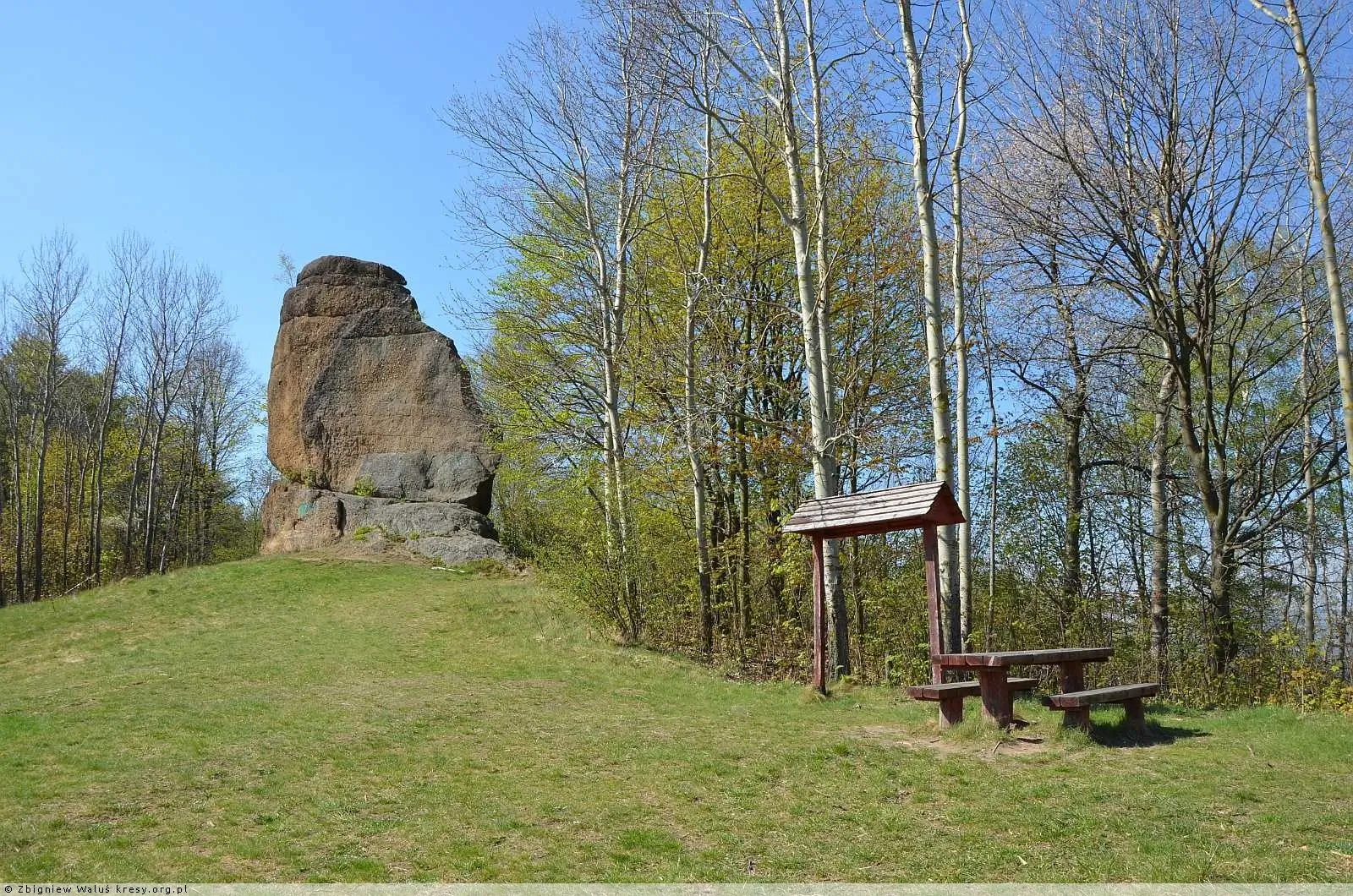
Pasterskie Rocks near the village of Idzików is one of the least known, yet most beautiful and mysterious corners of the entire Kłodzko Land. A group of seven monumental rock outliers, built of conglomerate, rising up to 10 meters in height, stretches for about 200 meters along the ridge of a hill in the Idzików Upland. This charming place, covered in the legend of four shepherd brothers who fell victim to divine punishment for their wickedness, attracts climbers looking for unique challenges, as well as tourists seeking authenticity, silence, and contact with nature. The rocks, recognized as a natural monument, are not only a geological treasure, but also a testament to the turbulent geological events that took place millions of years ago, when the Śnieżnik Massif] rose upwards from rocks from the Cretaceous era.
Geological Genesis – Millions of Years of Nature’s Effort
The history of Pasterskie Rocks does not begin thousands of years ago, as it might seem, but dates back millions of years – to a time when the shape of the entire Kłodzko Land and Sudetes was still completely different.
Upper Cretaceous Sandstones and Conglomerates – The Building Material of the Rocks
The material from which <span class="group-hover/language-learning:border-foreground
Pasterka Rocks are Upper Cretaceous sandstones and coarse-grained conglomerates, mainly quartz – that is, stone that was formed on the bottom of ancient seas in the Cretaceous period, about 100–66 million years ago. In those days, the area of today’s Sudetes was covered by a deep sea – oceanic abysses that slowly accumulated sand, gravel and pebbles (rounded stones).
Layered deposition processes – layer after layer, millions of years of sedimentation – gradually created monolithic blocks of sandstone and conglomerate, which slowly bound and merged into a solid whole. These layers also contained pebbles of metamorphic rocks and Cretaceous marls – this created a heterogeneous, multi-layered geological structure.
Plate Tectonics and Alpine Orogenies – The Birth of the Sudetes
However, nothing happened in place. Around 20 million years ago (in the Paleogene and Neogene periods), Europe was undergoing dramatic transformations. As a result of the Alpine orogenies – that is, a subjective collision between the African and European tectonic plates – there were enormous stresses in the rock.
These stresses caused a flexure – that is, a bending of the rock layers. The layers that were previously horizontal suddenly bent vertically. This process is called dislocation – a change in the structure of the rock as a result of tectonic forces. Layers of sandstone and conglomerate, which millions of years ago lay horizontally on the seabed, suddenly bent perpendicular to the ground!
Erosion – The Artist Who Gave Form
When the rock was lifted and placed vertically, the second phase of creation began – erosion. For millions of years, rain, frost, water currents, winds worked on the scale, destroying soft fragments, leaving hard ones. Less resistant layers were washed away – only the hardest blocks of quartz conglomerate remained, which formed into today’s seven characteristic tors.
Pasterka Rocks are therefore the only group of tors in this region that have survived from the vertical fragment of the flexure – what is left of the tectonic drama that took place tens of millions of years ago.
Rock Morphology – Architecture Created by Nature
Seven Tors – Each with its Peculiarity
Pasterka Rocks consist of seven distinct formations, although only four of them reach sizes of interest to climbers:
Four Main Climbing Rocks:
- Dyskobol – First and most attractive with a view from the parking lot, up to 15 meters high. The name comes from the Greek sculpture of the Athlete, meaning “throwing the disc”. The rock has a characteristic shape – flat on one side, composed of large stones and small pebbles cemented in a sandstone mass. It offers a specific type of climbing, where you have to get used to climbing conglomerate.
Oszczepnik (Javelin Thrower) – The second rock, just as impressive as Dyskobol, also about 15 meters high. The name means throwing a javelin – a reference to Greek sculptures. This rock is distinguished by its spire and blade forms.
and 4. The other Two Main Rocks – with heights between 10-12 meters, offering less extravagant, but still solid climbing possibilities.
Three Smaller Formations – Boulders and Sedimentary Rocks:
The remaining three formations are smaller rock formations and pebbles – evidence of less resistance to erosion, but still geologically interesting.
Characteristic features
Each rock has its own characteristic form:
Flat Walls – vertical walls offering a technical challenge
Spires – pointed peaks, requiring precision and balance
Blades – knife-thin edges, where you have to find balance between the walls
The conglomerate material gives a specific texture – it is not smooth sandstone, but a rough structure formed of large stones and small pebbles. Climbers talk about “specific conglomerate climbing” – that is, the climbing technique must be adapted to this material.
The Legend of the Four Brothers – A Story of Punishment for Wickedness
If geology explains *how* Shepherd Rocks were created, the legend explains *why* they are there. And it is a legend full of morality, fear and divine punishment.
A Story Told Through Generations
The story has been circulating among the local people of the Kłodzko Land for centuries. Here is the version recorded in tradition:
Four Young Brothers:
<p class="my-2 [&+p]:mt-4 [&_strong:has(+br)]:inline-block
Long ago, on a hill where today stand Shepherd Rocks, lived a poor boy – a shepherd. He had four sons, to whom he entrusted the care of his sheep and cows. The brothers would come to the meadow to graze the animals, but they did not cultivate this profession with humility and respect.
Frustration and Animal Suffering:
Instead of caring for the well-being of the animals, the brothers took out their frustration on them. They tormented the sheep and cows, rode them mercilessly, and tortured them, disregarding their suffering. They were unfulfilled, did not appreciate their work, and felt humiliated by having to work as simple shepherds.
Bread with Cottage Cheese – Turning Point:
One day, while on the meadow, the brothers unpacked a bag with food prepared by their mother. They were expecting meat – what else? – the prestige food for the nobility. But inside, they found traditional bread and plain cottage cheese. It was the same thing they ate every day. Instead of thanking their mother for her effort, the brothers became angry.
Blasphemy and Wickedness:
In anger, they threw the food on the ground and began to trample it, mocking their mother’s work and the gifts they received. They cursed their routine, their poverty, their work. It was not only wickedness – it was a blasphemous disregard for their mother’s sacrifice and a lack of gratitude.
God’s Storm and Lightning of Punishment:
At that moment – when the brothers were still at the height of their anger – a huge storm broke out over the hill. The sky darkened, thunder rolled, and lightning began to strike the ground. These were not ordinary lightning bolts – they were lightning bolts of divine punishment.
Transformation into Stone – Eternal Punishment:
The lightning struck the four brothers directly, turning them into stone. These are the four main rocks that we see to this day – an eternal monument to their wickedness. The lightning also struck the dog that accompanied them – the dog turned into the fifth, smallest rock. And a few sheep that suffered at their hands – turned into the surrounding boulders.
Moral Lesson:
The legend contains a clear message – nature, fate, god punishes wickedness. Whoever takes out frustration on innocent animals, whoever disregards the work and sacrifices of loved ones, whoever complains instead of giving thanks – will be condemned to eternal stillness, turned into a stone without movement, without the possibility of change.
Legend Variants
In regional accounts, there are variants of this story. In one variant, the father is included in the story – the shepherd who left his sons in charge of the animals was also turned into stone for neglecting his duties.
However, the core of the legend always remains the same – it is a story about punishment for wickedness, a terrible story that could have been passed down to children to teach them respect for work,
for animals and for victims of the family.
Geological Significance – Natural Monument
Regardless of the legend, Pasterskie Rocks have serious scientific significance. In 1993, they were legally protected as a natural monument. This status means that the rock formation is protected from degradation and destruction – it is not allowed to demolish here, it is not allowed to change the terrain without the consent of nature conservation authorities.
The rocks constitute documentation of upper geomorphological processes – they are a living textbook for learning about how plate tectonics and erosion shape the landscape.
Climbing – Sport in the Heart of Nature
For climbers, Pasterskie Rocks are a small but valuable climbing area. They are not staggering in height – the highest reach 15 meters – but offer a specific challenge.
Climbing Characteristics
Conglomerate Material:
The conglomerate from which the rocks are built is a difficult material. It is not as smooth and discreet as granite, but it is also not as maliciously sharp as sandstones sometimes are. Climbers talk about “specific greasing” – this means that you have to get used to the texture and style of climbing on this material.
Climbing Routes – From Beginner to Advanced:
Routes range from class III (for beginners) to VI.4 (for advanced). The names of the routes are creative and playful:
Descent – class III, training route
Myk Myk – V+, more demanding
Corner – class V
Afterparty – VI.1, for advanced
Jozin z Bazin – VI.1+, difficult
Wailing Wall – VI.4
najwyższa kategoria
The routes are both bolted (with bolts) and TRAD (traditional – climbers protect themselves with gear).
Specifics of Climbing at Pasterskie
Seasonality: Autumn and early spring are the best times. There is a lot of vegetation in the summer and – be careful – ticks
Specific Holds: Many holds and steps, but you need to get used to the structure of the conglomerate
Focus: This is not a spectacular area with large walls, but a more intimate climbing experience in the context of nature
Tourism – For Those Who Seek Peace
For those who are not climbers, Pasterskie Rocks also offer a rich tourist experience.
Infrastructure
The place is equipped with:
Shelter/Gazebo – shelter from the rain
Campfire Site – you can organize a picnic with grilling
Information Board – describing the history and geology of the rocks
Benches – for relaxing and admiring the views
Panorama – Views of the Śnieżnik Massif
From the top of the Idzików Upland, where the rocks are located, there is a spectacular panorama of the surrounding mountains:
Czarna Góra (Black Mountain) – a characteristic peak with views
Igliczna – with the Sanctuary of Mary of the Snows
Krowiarki Range – a picturesque mountain range
Upper Nysa Trench – river valley
The views are particularly beautiful in spring (flowering daffodils) and autumn (golden colors of the leaves).
Access – Close and Easy
Getting there: From Idzików – turn left onto the asphalt road towards the village of Kamienna. After driving about 500 meters, the rocks are visible on the left on a hill
Parking: Bay at the bend in the road
Walking: About 5 minutes through slightly steep terrain
Stroller: Not recommended – the terrain is too steep
Practical Info
Best Time: Spring (March–May) and autumn (September–October)
Avoid: Summer due to vegetation and ticks
Paths: There is no formal marked trail, but the road is easy to find
Why Shepherd Rocks Are Worth a Visit
Shepherd Rocks are a place that combines several unique aspects:
Geological: They are testimonies to Alpine mountain movements and erosion – documentation of the variability of our planet.
Mythological: The legend of the four brothers, although perhaps not historically provable, carries a timeless message about morality and punishment for wickedness.
Sporting: For climbers, it’s a challenge –conglomerate rocks require a specific technique.
Aesthetic: The landscapes of the Idzików Upland and the surrounding panoramas of the Śnieżnik Massif are beautiful – especially in the changing seasons.
Peaceful: This is one of the lesser-known places – ideal for those looking to avoid crowds of tourists and enjoy nature in silence.