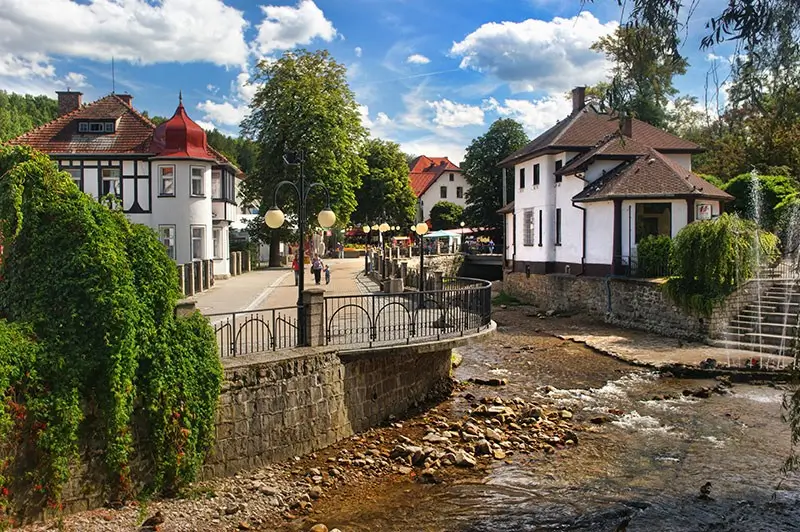
Polanica Zdrój is one of the most visited health resorts in the entire Kłodzko Valley – a picturesque town located in the heart of Lower Silesia, where history dates back to 1347, and the legend of its creation is associated with an extraordinary adventure of a forester and a magical bear. This is a place where mineral waters – especially the famous Wielka Pieniawa, extracted from a depth of over 34 meters underground – heal the bodies and souls of the spa guests who have been coming here from the 19th century until today. The history of the town is a story of transformation – from a medieval village surrounded by dense forests (the name “Heyde” meant “wilderness” or “glade”), through the 19th-century spa and tourist boom under Prussian rule, to the modern Polish resort. Today, Polanica Zdrój is a place where centuries-old rhododendrons defend against logging, the Spa Park smells of bygone times, and the monument to the Polanica Bear – commemorating the farthest reach of the Scandinavian ice sheet – reminds of the glacial past of this area.
History – From Medieval Wilderness to a World-Class Health Resort
1347 – First Mention – “zu Heyde”
The history of Polanica Zdrój dates back to the deep Middle Ages. In 1347, in the Kłodzko chronicles of the nobility courts, a settlement called “zu Heyde” – meaning “at the Wilderness” or “at the Glade” – is mentioned for the first time.
This first mention concerned the goods belonging to the von Glaubitz family (also known as von Glubos) – nobility residing in Szczerba Castle.
The proper settlement of Polanica was probably managed by Nikolaus von Glubos, and his brothers Otto appeared in documents in 1353.
Middle Ages – Wilderness, Jesuits, Swedes
For many centuries, Polanica remained a small, inconspicuous village surrounded by dense forests. Visitors drew from the springs located here, but there was a lack of systematic development.
In 1557, the chronicler Georgius Aelurius noted in his work “Glaciographia” (description of the Kłodzko Land) that there are mineral springs in the vicinity of the village. This was the first scientific information about the health resources of the area.
However, the real development was brought by the Jesuits, who developed the areas around the springs. However, this period of development was brutally interrupted – in 1645, the Swedes from Colonel Douglas’s unit destroyed Polanica during the Thirty Years’ War.
1556 – The Creation of Nowa Polanica
Around 1556, Nowa Polanica (Neuheide, today Polanica Górna) was established on the northern edge of the village.
As a result, the proper Polanica began to be called Stara (Altheide, Alt-Heide, Alt-Haide).
The division into Stara and Nowa Polanica lasted for centuries – and differed geographically and administratively.
19th Century – The Boom of the Health Resort
Everything changed dramatically in the 19th century, when the phenomenon of spa tourism spread throughout Europe.
<p class="my-2 [&+p]:mt-4 [&_strong:has(+br)]:inline-block
1873 Year – Wenzel Hoffmann and the Birth of the Modern Spa:
In 1873, Wrocław industrialist Wenzel Hoffmann acquired the spring and surrounding areas. This was a key moment.
What did Hoffmann do?
He built an extensive Spa Park – with walking alleys, flower beds, wooden pavilions
He built a new Mineral Water Pump Room – an elegant complex for spa guests
He built a Spa House – a health resort with comfort for guests
He built a Theater – for the entertainment of spa guests in the evenings
The health resort began to attract wealthy guests from all over Europe.
1890 Year – Railway Line:
A key element of the transformation came in 1890, when a railway line from Kłodzko was brought in.
Why was this important? Transportation! Before the railway, arriving in Polanica took days – by stagecoach, on horseback. After the railway – a few hours from Wrocław!
The number of spa guests increased dramatically.
1904 Year – Georg Haase and a World-Class Spa:
In 1904, the spa areas were acquired by a company led by Wrocław trade councilor Georg Haase.
Haase was a visionary – he decided to make Polanica the most modern spa in Silesia.
1906 Year – Opening of the Luxurious Spa House:
In 1906, Haase opened a new Spa House (today the Wielka Pieniawa sanatorium) – a complex with 130 rooms and a modern hydrotherapy facility.
It was considered the most modern spa in all of Silesia.
1909–1911 Years – Expansion:
1909 Year: Construction of the cardiology sanatorium was completed
1911 Year: A complex with a water pump room, a promenade-concert hall, a cafe was openedzdrojową
Polanica Zdrój became a world-famous European resort.
World War I – Suspension of Development
At the beginning of World War I, the spa was closed, and the Spa House was transformed into a military hospital for wounded German soldiers.
However, operations were resumed after just one year – the demand for spa tourism was so strong that even the war could not stop it.
1925 – Official Name Change
In 1925, a formal name change was made – from “Altheide” to “Altheide-Bad”.
Fun fact: “Bad” means “spa” in German – but in the case of Polanica, the word was placed at the end of the name, which was the only such case in the German-speaking area!.
People usually said “Bad Altheide”, and this was the only town where “Bad” was at the end instead of at the beginning.
The Legend of the Little Bear – The Forester and the Magic of the Waters
Polanica Zdrój would not be special without its legend – a story about an unusual bear and a forester, which explains the origins of the mineral springs.
The Legendary Tale
Long, long ago, when these lands were overgrown with dense forests, a certain forester (a forest ranger, guardian of the forest) set out on a hot day to patrol the area.
After a long march, he felt extremely tired and thirsty. He found a small spring and bent down to drink.
But at that moment, a powerful bear lunged at the spring!.
A fight. The forester was strong – after a short scuffle, he knocked the animal onto its back. He intended to plunge his knife into its heart.
Then the bear speaks (in the legend, animals speak):
“Do not kill me, and I will show you water that is much tastier!”
The forester, surprised but interested, freed the bear.
The animal led him to a clearing, where water with a strange smell and taste gushed from a spring.
The young man drank this water – and soon his fatigue disappeared.
After fulfilling his mission, the bear disappeared into the forests.
The Spread of the News
The news of the extraordinary water quickly spread throughout the area.
People began to arrive from distant lands, wanting to experience the healing power of this water.
Around the glade, a settlement began to form, which after years was named Polanica – from the word “polana” (glade).
Scientific Reality – The Polar Bear from 1910
But don’t forget – the legend has its scientific explanation!
In 1910, German glaciologists (scientists studying ice sheets) conducted thorough geological research.
They came to the conclusion that the Scandinavian ice sheet stopped exactly at the height of present-day Polanica-Zdrój.
To commemorate this boundary of the last glaciation, German scientists and the local community decided to place a concrete sculpture of a polar bear in the park.
It was placed on a foundation of volcanic tuff.
The polar bear has been standing there since 1910 – for over 110 years – indicating the point reached by the Scandinavian glaciers one and a half million years ago!
Thus, legend and science have merged into one!
Mineral Waters of Polanica – Healing Springs
The heart of the spa are mineral waters – natural springs that come from the earth rich in medicinal minerals.
Wielka Pieniawa – The Most Famous Spring
Wielka Pieniawa is the oldest and most famous water from Polanica.
History:
1904 Year: First drilling in search of new mineral springs
May 1904: Success! A hole was drilled in a sandstone fault – a new spring was created
Original Name: “Gertruda”, but after a year it was renamed “Wielka Pieniawa”
Water Characteristics:
Extraction Depth: Over 34 meters underground
Properties: The water flows artesian – it extracts itself, without pumps, thanks to natural pressure
Mineral Components: Rich in magnesium, calcium, iron, sodium, chlorine, silicon, lithium, copper and potassium
Daily Production: Over a million liters per day – an incredible amount!
Pieniawa Józefa (Staropolanka)
This is the second important source, named “Karolina” upon its discovery in November 1904 – very efficient.
Other Names: “Pieniawa Józefa” (1950s), “Staropolanka” (today)
Depth: Two intakes – one at 88.9 meters, the other at 43 meters
Medicinal Indications
Polanica waters heal a wide range of ailments:
Digestive System Diseases: Large intestine disorders, liver and pancreas diseases, hyperacidity, diabetes problems
Cardiovascular Diseases: Heart and blood vessel problems
Urinary System Diseases: Kidney stones
Alcohol Poisoning: Waters support detoxification
Mineral Water Pump Room – Spa Complex
Mineral Water Pump Room “Wielka Pieniawa” is the main health resort center.
Infrastructure:
36 Bathing Cabins: For treatment
60 Sanatorium Rooms: For patients
Promenade Hall: Decorated, elegant – ideal for walks between treatments
Restaurants, Cafes, Confectioneries: For gastronomic delights
Reading Room: For intellectual relaxation
<h2 class="mb-2
Spa Park – An Oasis of Greenery and Movement
Spa Park is a historic garden, the main tourist attraction and recreation area.
Park Elements
Age-old Rhododendrons: Under strict protection – some are over 100 years old
Chess Park: With figures 140 cm high – you can play chess!
Polar Bear: A monument to the ice sheet – the main attraction
“Little Bears” Monument: A newer attraction depicting a bear cub drinking water
Walkways and Avenues: Beautifully maintained walking paths
Basketball Stars Avenue
On the promenade by the Bystrzyca Dusznicka is the Basketball Stars Avenue with handprints of famous basketball players.
It is a tourist attraction, but also evidence of Polanica as a center of sports and tourism.
Historical Facts
Maria Dąbrowska – Polish Writer
Among the spa guests was Maria Dąbrowska, a famous Polish writer, author of “Nights and Days.”
Mieczysław Fogg – Singer
Mieczysław Fogg, a famous Polish tenor, also stayed in Polanica-Zdrój.
Irena Santor – Artist
Irena Santor, a famous Polish vocalist, studied at the Glass Decoration Gymnasium, and then at the Glass Technology School in Polanica-Zdrój.