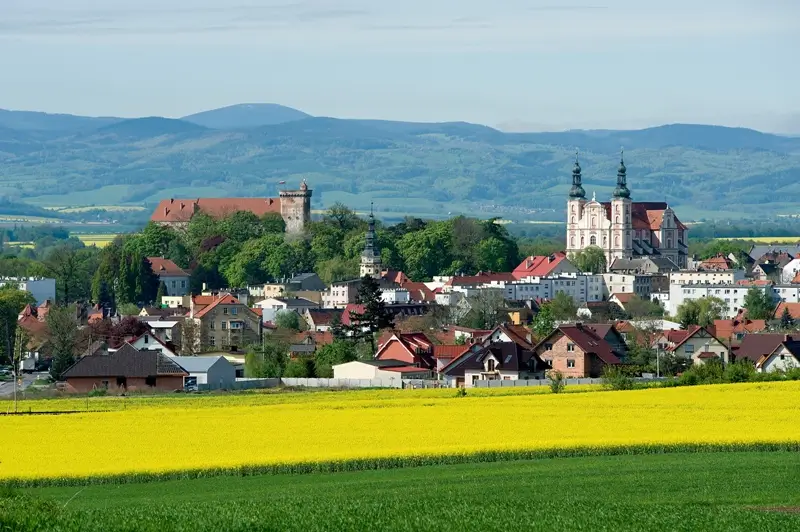
Otmuchów is one of the oldest towns in Silesia – a castellan town mentioned as early as Pope Adrian IV’s bull of 1155, when the Bishop of Wrocław possessed these lands as an important administrative and defensive point. This is a town whose name probably means “Dark Forest” or “In the Dark Forest” (from the earliest German form Othemochow from 1103), for centuries served as a defensive stronghold of the bishops of Wrocław, a place for church treasures, and an arena for battles against the Hussites, Prussians, and other hostile forces. However, the history of Otmuchów is not only about medieval splendor – it is also a story of the tragedy of World War II, when the Germans created Polenlager 86 here – one of the concentration camps intended exclusively for Poles, where entire families were kept in inhumane conditions, forcing them into slave labor. The most horrific crime took place on April 13, 1945, just before the town’s liberation, when a German doctor from the NSDAP murdered 26 mentally ill patients at St. Joseph’s Hospital – defenseless people who had no chance of defending themselves.
History – From Medieval Stronghold to Residence of Bishops
1155 – First Mention – Pope Adrian IV’s Bull
The history of Otmuchów officially begins in 1155, when Pope Adrian IV issued a bull confirming the possessions of the bishops of Wrocław – and Otmuchów appeared among the mentioned castellan towns.
What does “castellan town” mean?
A castellan town is a fortified administrative and defensive settlement, headed by a castellan – an official representing the ruler (in this case, the bishop) and exercising power over a specific territory.
Otmuchów was one of the oldest such towns in Silesia – which testifies to its strategic importance as early as the Middle Ages.
1290 – Henryk Probus’s Will – Handing Over to the Bishops
The long-standing dispute between Prince Henryk IV Probus and Bishop Tomasz II over the possession of Otmuchów ended in 1290, when the dying prince in his will handed Otmuchów over to the bishops of Wrocław.
From that moment on, Otmuchów became the official seat of the prince-bishops of Wrocław – the capital of their spiritual and secular rule.
14th Century – Expansion under Przecław of Pogorzela
The greatest development of the castle and town occurred during the time of Bishop Przecław of Pogorzela (1341–1376).
What did Przecław do?
Rebuilt the castle on the plan of its predecessor (which was destroyed)
He connected the castle walls with the city fortifications – creating an integrated defense system.
He fortified the bishop’s treasury, which was located in the castle.
Thanks to these works, Otmuchów became a difficult fortress to capture.
1430 – Treacherous Capture by the Hussites
Despite the strong fortifications, in 1430 the Hussites (religious revolutionaries from Bohemia) treacherously captured Otmuchów.
After capturing it, they themselves expanded and fortified the castle, making it even stronger.
This was a painful loss for the bishops of Wrocław – both prestigious and financial.
1484–1485 – Late Gothic Expansion
After recapturing the castle, Bishop John IV Roth carried out a thorough modernization in the style of late Gothic (1484–1485).
He emphasized the defense system – adding new towers, barbicans and bastions.
1585–1596 – Renaissance Residence
Another transformation came with Bishop Andrzej Jerin, who in 1585–1596 transformed the medieval castle into a Renaissance residence.
It was no longer just a fortress – it was an elegant palace, worthy of a European magnate.
1625–1665 – Baroque Reconstructions
After the destruction of the Thirty Years’ War, the castle was rebuilt by Charles Ferdinand Vasa (1625–1665).
He introduced baroque elements, including the famous “horse stairs” – wide, gentle stairs that made it easier to carry a sick bishop in a litter.
1706–1707 – Lower Castle
Bishop Ludwik Franciszek Neuburg built a new residential wing and a lower castle in the western part of the complex (1706–1707).
Otmuchów reached the peak of its splendor.
1741 – Silesian War and Destruction
However, disaster struck in 1741, during the Silesian War, when Prussian troops attacked and destroyed the northern and western parts of the castle.
The castle was partially rebuilt, but it never returned to its former glory.
The bishops moved out of the city taken over by Prussia – Otmuchów lost its administrative importance.
1810 – Secularization
<p class="my-2 [&+p]:mt-4
In 1810, as a result of secularization (the seizure of church property by the state), the city and castle passed into the ownership of the Prussian state.
The castle became the property of the Hohenzollerns (the Prussian royal family), who then gifted it to other countrymen for state services.
World War II – Polenlager 86 and Murders of the Sick
However, the most tragic chapter in the history of Otmuchów was written during World War II, when the Germans established Polenlager 86 here – one of the concentration camps intended exclusively for Poles.
Polenlager – “Camps for Poles”
Polenlager (Polish: “camps for Poles”) is a system of special concentration camps established by Nazi Germany exclusively for the Polish population.
Purpose of the Camps:
Biological destruction of the Polish nation – through terror, abuse, forced labor
Isolating the Polish intelligentsia – teachers, craftsmen, farmers considered “politically unreliable”
Forcing Germanization – signing the Volksliste (German nationality list) and agreeing to military service in the Wehrmacht
Polenlager 86 in Otmuchów
Polenlager 86 was located in the Grodków district in the Opole Regency.
Location:
Wooden barracks – 150 meters from the railway station
Barbed wire fence – to prevent escape
Start of operation: Around August 1941
Conditions in the Camp:
Deprivation of all property – looting of all movable and immovable property
Slave labor – forcing everyone to work, including minors
Political terror – mistreatment, atrocities, the principle of collective responsibility
Roll calls twice a day – at 6:00 a.m. and 8:00 p.m. – everyone had to appear, even infants
Euthanasia – killing the elderly, sick and infirm
Shooting at escapees – the crew used firearms against those trying to escape
Number of Victims:
The exact number of prisoners and victims is unknown because the Germans destroyed the documentation at the end of the war.
Careful estimates speak of 20–30 thousand prisoners in all Polenlagers combined, and the number of victims is several thousand dead.
April 13, 1945 – Murder of Patients at St. Joseph’s Hospital
The most terrifying crime in Otmuchów took place on April 13, 1945 – just a few weeks before the end of the war.
German Doctor from the NSDAP
A German doctor, a member of the NSDAP (National Socialist German Workers’ Party – the Nazi party), murdered 26 mentally ill patients of St. Joseph’s Hospital in Otmuchów.
Context – Euthanasia Program T4
This murder was part of the broader euthanasia program T4 – the Nazi action to exterminate people with mental and physical disabilities.
Nazi Ideology:
Nazi ideology defined the mentally ill as “unable to coexist socially and leading a life unworthy of life”.
Poles were treated as “subhumans”, Jews stood even lower, but the mentally ill were placed at the very bottom of this degenerate hierarchy.
Murder Methods
Germans used various methods to kill the mentally ill:
- <p class="my-2 [&+p]:mt-4 [&_strong:has(+br)]:inline-block
Shots to the back of the head
Wooden clubs
Gas (in special gas chambers)
Starvation – limiting food rations to a minimum
Taking them on “excursions” – disabled children were taken to forests and shot like game
Scale of the Crimes in Poland
In total, the perpetrators (Germans and Austrians) murdered approximately 20,000 citizens of the Second Polish Republic suffering from mental illnesses.
13 thousand were killed in large psychiatric institutions
The rest were residents of social welfare institutions, disabled children from church care centers
“Training Ground for the Holocaust”
The murders of the mentally ill were a “training ground for the Holocaust” – the Germans developed and perfected methods of mass killing during these crimes.
The first victims of gassing by the Germans were Polish mental patients – the same methods were then used during the Holocaust against Jews.
May 8, 1945 – Liberation
On May 8, 1945 Otmuchów was liberated by units of the 286th Infantry Division of the 115th Infantry Corps of the 59th Army from the 1st Ukrainian Front (Red Army).
Memorials
1970: A monument was unveiled in honor of the fallen Soviet soldiers at ul. Parkowa
1973: A monument to Colonel Orłow was erected at ul. Krakowska – commander of the 6th Mechanized Corps of the 4th Guards Tank Army, Hero of the Soviet Union, who died near the city on March 18, 1945
Contemporary Otmuchów – City of Remembrance
Today, Otmuchów is a peaceful town that tries to remember its difficult history, but also show the beauty of its heritage.
CastleOtmuchów
The castle still dominates the city – a monument of national importance, entered in the register of monuments.
You can visit it, admire the architecture and understand what the life of Wrocław bishops was like for centuries.
City Coat of Arms
The coat of arms of Otmuchów – granted in 1347 – depicts an open city gate in white on a blue field.
Since the 14th century, this gate has been on the seal used – a symbol of an open city, but also a defended one.
Statue of the Executioner’s Wife
One of the peculiarities of the city is the unique statue of the executioner’s wife – located in hiding.
According to legend, on St. John’s night, young maidens dabbling in magic predict what their future husband will be like at it.