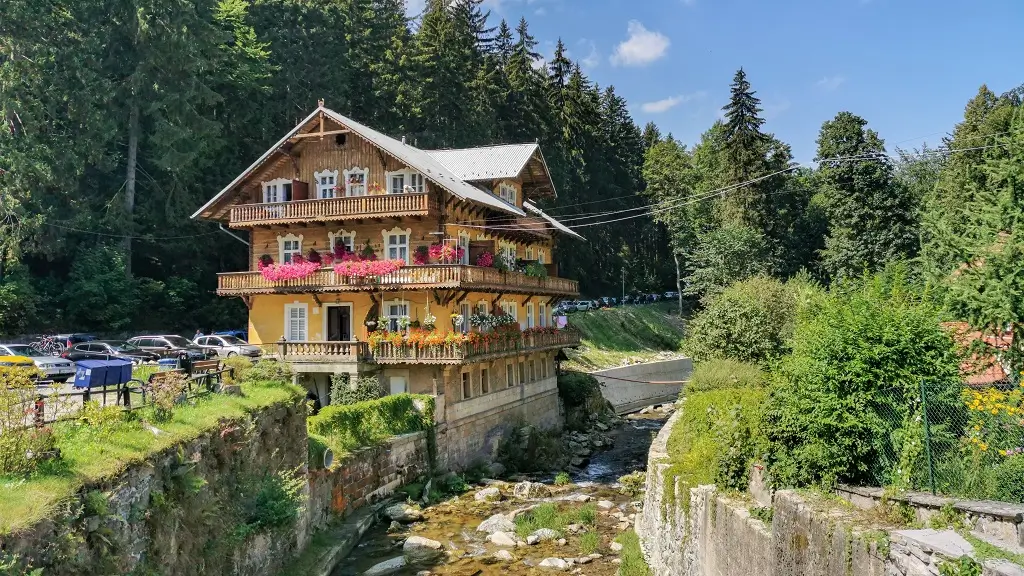
Międzygórze, located in the heart of the Śnieżnik Massif at an altitude of 570–750 meters above sea level, is one of the most beautiful places in the entire Sudetes – a small village of only 700 inhabitants, nestled between the mountain slopes like a pearl surrounded by emeralds. This charming town, also known as “Little Switzerland”, attracts not only tourists seeking peace and natural beauty, but also filmmakers looking for ideal locations – it was here in 1965 that the cult series “Four Tank-Men and a Dog” was filmed, here were created scenes that for decades delighted millions of Poles. The characteristic architecture in the Tyrolean and Scandinavian style, beautifully preserved villas from over a hundred years ago with wooden carvings, balconies surrounding entire floors and rich carvings – all this makes a walk around Międzygórze like a journey back in time to the elegant, 19th-century times, when the most beautiful mountain resorts in Europe were created here.
History of Międzygórze – From Lumberjacks and Charcoal Burners to a Royal Resort
16th Century – First Settlements: Lumberjacks and Charcoal Burners
The history of Międzygórze dates back to the 16th century, when the first settlers arrived in this still uninhabited valley. However, these were not wealthy people or nobility – they were ordinary lumberjacks and charcoal burners, people working in the forest, cutting down trees and burning charcoal.
Lumberjacks were looking for dense forests – and there were plenty of them in the Śnieżnik Massif. Charcoal burners, on the other hand, burned wood into charcoal, which was needed by foundries and forges to melt ore. It was hard work, but profitable.
The first settlements in Międzygórze were probably work buildings – sheds, warehouses, shelters for workers. Nothing magnificent – just functional.
19th Century – Revolution: Princess Marianna Oranska
The breakthrough came in 1840, when Princess Marianna Oranska bought the surrounding estates along with Międzygórze. Marianna Oranska was a great person – a Dutch princess whose life led her to Silesia.
Who was Marianna Oranska? She was a visionary woman who understood the potential of tourism and health. Thanks to her, the entire Kłodzko Land region underwent a transformation – from a poor, forested area to an elegant mountain resort.
Changes Introduced by Marianne of Orange:
Built a Network of Roads – roads leading to Śnieżnik Mountain and neighboring villages.
Regulated Streams – the Wilczka River, which flows through Międzygórze, was regulated to ensure safety.
Built Her Own Villa – a Tyrolean-style residence that was a model example of the architecture she wanted to promote.
Cared for the Uniformity of Architecture – every new building in Międzygórze was to be built in the Tyrolean style, giving the place a unified, picturesque appearance.
1882 – The Establishment of the First Sanatorium
In 1882, some 40 years after Międzygórze was bought by Marianne of Orange, an entrepreneur appeared who saw enormous potential – the potential of the health resort business.
This man understood that the greenery, clean air and beautiful landscapes of Międzygórze could attract wealthy people seeking health. In the 19th century, health resorts were fashionable – people believed that special mountain air could heal lungs, nerves, and the heart.
He opened the first sanatorium complex in Międzygórze, of course in the Tyrolean style. Success was immediate – there was no shortage of people wanting spa holidays. Quickly, other guesthouses, hotels, and holiday homes were built – all in the same beautiful style.
20th Century – From Health Resort to Tourist Resort
In the 20th century, Międzygórze developed beyond the health resort business. It first became popular as a summer resort – for wealthy people seeking peace and quiet. Then, during the communist era, it became a holiday center for workers and tourists.
However, it did not lose its character – Tyrolean architecture, beautiful landscapes, clean air – all of this has survived.
The Architecture of Międzygórze – Fascination with the Tyrolean Style
What makes Międzygórze unique is its uniform Tyrolean-style architecture. Almost every building in the town – from small houses, through guesthouses, to large holiday homes – was built in this distinctive style.
<h2 class="mb-2 mt-4 font-display font-semimedium text-base
Features of Tyrolean Architecture in Międzygórze
Characteristic Elements:
Wooden Carvings – every balcony, every balustrade, every arcade (an open gallery around the house) is richly decorated with wooden carvings
Balconies Surrounding Entire Floors – the most impressive is the boarding house development with characteristic balconies surrounding entire floors
Richly Decorated Woodcarving Forms – every wooden surface becomes a canvas for carpentry artists
Large Windows – allowing access to light and enabling views of the landscapes from inside the houses
Gentle Roofs – characteristic of alpine architecture
Comparison to Swiss Houses
Międzygórze really resembles a small Swiss town – hence the name “Little Switzerland”. However, it is not so much a copy of Switzerland as an Alpine inspiration – a style that comes from the border areas between Austria, Switzerland and Italian Tyrol.
Historical Value – Protection and Renovation
Many of these beautiful buildings, built over a hundred years ago, have survived to this day. Some of them have been carefully restored and serve as guesthouses or hotels. Unfortunately, some of the buildings have not been restored and one can only guess how beautiful they must have once looked.
“Four Tank-Men and a Dog” – When Międzygórze Played Siberia
One of the most attractive episodes in the history of Międzygórze] was its appearance in the film. In 1965, Międzygórze became the location for the iconic series “Four Tank-Men and a Dog”.
Freezing February 1965 – The Beginning of the Legend
Freezing February 1965. A modest film crew under the direction of director Konrad Nałęcki arrived in Międzygórze to shoot scenes for the war series. None of the crew suspected that they were creating one of the most popular Polish series of all time.
Międzygórze as SiberianTajga
The scenery of Międzygórze – snowy mountains, pine forests, frosty air – was perfect for playing the part of the Siberian taiga, where Janek Kos, the main character of the series, spent his youth.
Scenes filmed in Międzygórze:
Janek Hunts a Tiger – the famous scene in which young Janek defends his companions from a tiger
Fight with a Japanese Paratrooper – a dramatic fight scene
Attempting to Enlist in the Army – the first episode in which Janek tries to join the army
Crew Without Modern Safety Measures
It must be said that working conditions on set were terrifyingly dangerous compared to today’s standards. There were no modern safety systems, no large teams of people taking care of every detail.
Tragic Accident – Janusz Gajos Run Over by a Truck:
One of the biggest accidents on set involved the main actor himself – Janusz Gajos, who played Janek Kos. During filming, Gajos was run over by a truck.
What happened? Gajos was put in a cast, but even then he continued working on the series. He lay in a hospital room, and thanks to his real injury, he was perhaps more convincing in the role!
To accommodate his injury, the filmmakers even changed the order of the shots and filmed the hospital episode in which Janek was lying in the hospital. In outdoor scenes, Gajos was sometimes replaced by the Krakow actor Henryk Matwiszyn.
Broadcast and Success
The series was recorded in 1965, but it didn’t reach the public until May 1966, when the first episode premiered. From September 25, 1966, the series began to be broadcast regularly and quickly became a phenomenon.
Millions of Poles watched the adventures of the tank “Rudy 102” and its crew – and will always remember the scene in which young Janek Kos hunts a tiger in the Siberian taiga, and we know that it was Międzygórze that played that heavenly backdrop.
Other Film Productions
Międzygórze has not given up being a movie star. In addition to “Four Tank-Men and a Dog”, the following were also filmed here:
Series “WOW” (1991) – transforming into the fictional Laurentine, with stars such as Cezary Pazura and Anna Seniuk
Polish-American Film “White Dragon” (1986) – a fantasy film by directors Jerzy Domaradzki and Janusz Morgenstern
Series “Gazda z Diabelnej” (1979) and “Boża Podszewka II” (2005)
Main Tourist Attractions of Międzygórze
1. Wilczki Waterfall – The Second Highest in the Sudetes
Wilczki Waterfall is the second largest waterfall in the entire Sudetes, and the highest in the Śnieżnik Massif. The water drop is 22 meters – an impressive height.
It was formed on the tectonic fault line on the Wilczka River, which makes it not only beautiful but also geologically important. It is located right next to the trail leading to the Sanctuary of Mary of the Snows on Igliczna.
A few years ago, a thorough revitalization of the area surrounding the waterfall was carried out, which makes watching the waterfall now a safe, excellent entertainment for everyone.
2. Sanctuary of Mary of the Snows on Igliczna
Mount Igliczna, located near Międzygórze, hosts the Sanctuary of Mary of the Snows – an important pilgrimage site for Catholics. The trail to Igliczna starts in Międzygórze and is relatively easy, even for beginner tourists.
3. Garden of Fairy Tales – A Fairy-Tale Land
Międzygórze also hosts the Garden of Fairy Tales – a magical place full of wooden sculptures and fairytale characters. This place is particularly popular with families with children.
4. Flood Control Dam
The dam is located at the entrance to Międzygórze, about 200 meters from the main road. A green hiking trail towards Maria Śnieżna runs through it.
5. Marianna Orańska Trail – Transboundary Royal Trail
The “Transboundary Trail of Princess Marianna Orańska” is a modern tourist attraction dedicated to the woman who made this region famous. The trail runs through areas on both sides of the Polish-Czech border.
Hiking and Biking Trails – A Paradise for the Active
Międzygórze is a center of hiking and cycling tourism. Surrounded by the majestic Sudetes, it offers a number of routes of varying difficulty.
Hiking Trails
Trail to Szczeliniec Wielki: One of the most popular, leading to the top of Szczeliniec Wielki, from which there is a spectacular view ofcałe Sudety – trasa stosunkowo łatwa, idealna dla rodzin z dziećmi
Szlak na Śnieżnik: Trudniejsza trasa, ale z wiew widokowymi miejscami
Infrastruktura Szlaków
Trasy turystyczne w Międzygórzu są dobrze przygotowane i utrzymane. Większość szlaków jest oznakowana, a w strategicznych miejscach znajdują się tablice informacyjne, punkty widokowe oraz miejsca odpoczynku. Dla zapewnienia bezpieczeństwa, warto pamiętać o odpowiednim wyposażeniu, zwłaszcza podczas górskich wycieczek.
Noclegi i Obiekty Turystyczne
W Międzygórzu bez problemu można znaleźć noclegi – czy to w starych pensjonatach w stylu tyrolskim, czy w nowych gospodarstwach agroturystycznych. Znajdują się tam również kilka sklepów i punktów gastronomicznych.
Dla miłośników natury i spokoju, Międzygórze oferuje również domki i ośrodki wypoczynkowe położone wśród malowniczych górskich krajobrazów, które zapewniają dostęp do takich atrakcji jak grillowanie czy ogniska.
Dlaczego Międzygórze Jest Warte Odwiedzenia
Międzygórze to harmonijne połączenie historii, architektury, przyrody i kultury filmowej. To nie jest zwykła górska wioska – to jest żywe muzeum alpejskiego stylu życia, miejsce, gdzie każdy budynek opowiada historię, gdzie każdy szlak prowadzi do nowych odkryć, gdzie krajobrazy inspirowały najsłynniejszych polskich filmowców.
Spacer po Międzygórzu to jak przejście w czas – do eleganckich XIX-wiecznych czasów, kiedy to bogaci Europejczycy szukali ciszy i zdrowia w górach. To jednocześnie nowoczesne miejsce, w którym można aktywnie spędzić czas, wędrując po szlakach, oglądając wodospady, medytując w sanktuariach.
The entire Sudetes – a relatively easy route, ideal for families with children.
Trail to Śnieżnik: A more difficult route, but with picturesque spots.
Trail Infrastructure
Tourist routes in Międzygórze are well prepared and maintained. Most of the trails are marked, and in strategic locations there are information boards, viewpoints and rest areas. For safety, it is worth remembering to have appropriate equipment, especially during mountain trips.
Accommodation and Tourist Facilities
Accommodation in Międzygórze is easy to find – whether in old Tyrolean-style guesthouses or new agritourism farms. There are also several shops and catering points.
For lovers of nature and peace, Międzygórze also offers cottages and resorts located among picturesque mountain landscapes, providing access to attractions such as barbecues or bonfires.
Why Międzygórze Is Worth Visiting
Międzygórze is a harmonious combination of history, architecture, nature and film culture. It is not an ordinary mountain village – it is a living museum of Alpine lifestyle, a place where every building tells a story, where every trail leads to new discoveries, where the landscapes inspired the most famous Polish filmmakers.
A walk around Międzygórze is like stepping back in time – to the elegant 19th century, when wealthy Europeans sought peace and health in the mountains. It is also a modern place where you can actively spend time hiking the trails, watching waterfalls, and meditating in sanctuaries.