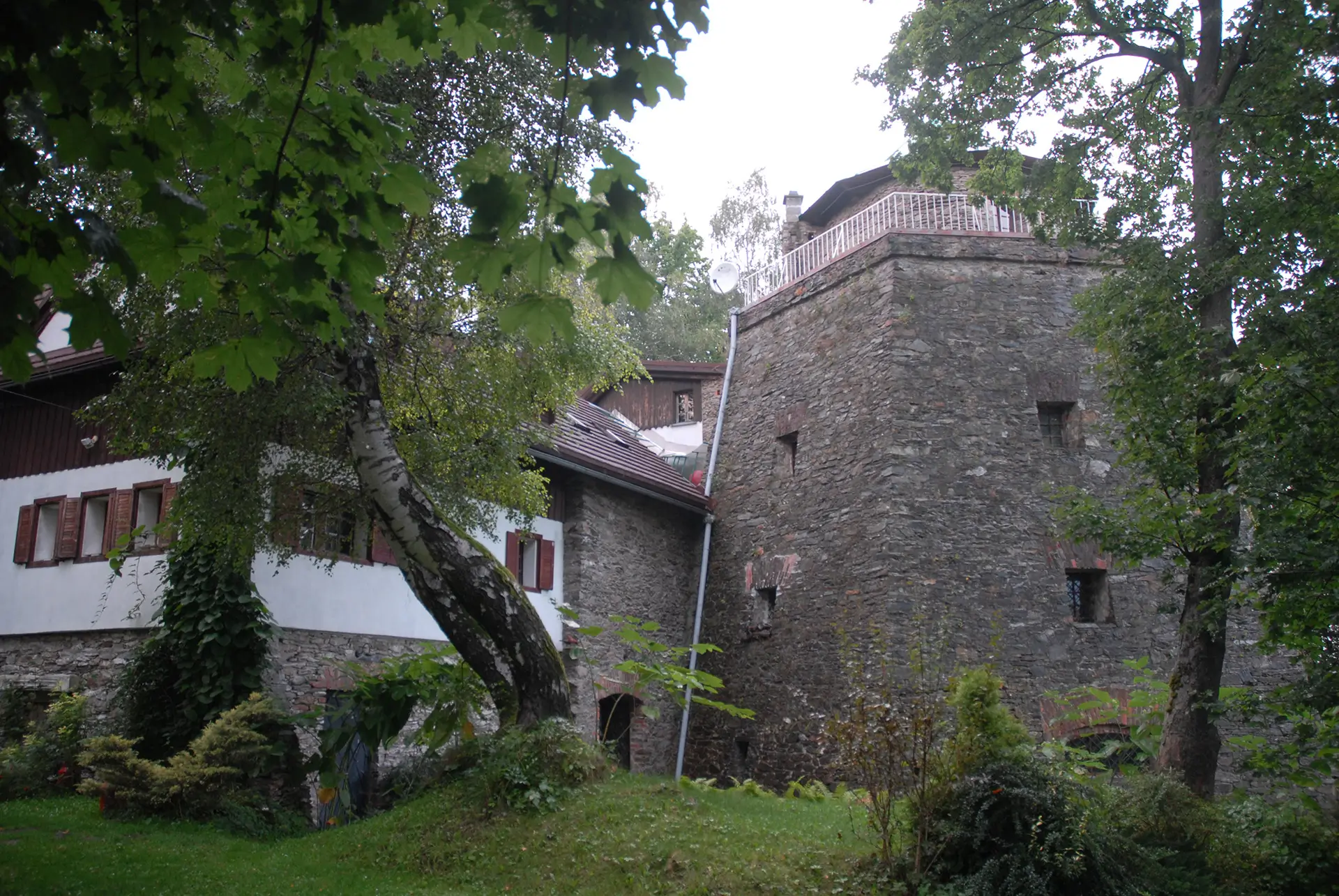
Łaskawy Kamień Limestone Kiln in Stara Morawa is an extraordinary place where history meets art, where old industrial technology has transformed into an artistic center, and nature has created a sanctuary for rare animals. It is not just an ordinary monument – it is a living work of art that changes everyone who visits it. The limestone kiln is the only originally restored Rumford lime kiln in Poland and the third in Europe, a 19th-century technical monument that has survived two centuries of economic, political, and cultural changes. Its history is a story of human determination, artistic passion, and deep respect for the past.
The History of the Limestone Kiln – From Revolutionary Technology to Ruin and Rebirth
The Birth of Genius: Rumford’s Kiln and Schinkel’s Vision
The historic limestone kiln in Stara Morawa was built in the early 19th century, most likely between 1820 and 1850. Its designer was the German architect Karl Friedrich Schinkel – one of the most outstanding figures of world classicism, a man who designed palaces for King Frederick William III and shaped the architecture of Berlin.
However, in designing the limestone kiln in Stara Morawa, Schinkel did not create an ordinary building. Instead, he implemented an innovative shaft furnace project based on the concept developed by Count Benjamin Thompson, also known as Count Rumford. It was a groundbreaking heating system enabling continuous lime production and much more efficient fuel use than traditional kilns.
The Revolutionary Rumford System – Technology of the Future
The limestone kiln’s hexagonal plan (which makes it unique among European limestone kilns) and the patented high-temperature maintenance system were advanced technical solutions for those times. Inside the kiln, the temperature reached 900–1000°C, which allowed the decomposition of calcium carbonate (CaCO₃) into calcium oxide (CaO) and carbon dioxide (CO₂).
The resulting quicklime had a wide range of applications:
In Construction: as a key component of mortar and plaster – without lime, it would not have been possible to build medieval castles, churches, or modern palaces
In Agriculture: to deacidify soils and improve their structure, improving yields and soil fertility
In the Chemical Industry: as a raw material for the production of hydrated lime (slaked), used in water purification and paint production
In Metallurgy: as a flux in metallurgical processes, facilitating the removal of impurities from metals – without lime, the German steel industry could not operate on such a scale
Golden Years of Operation – Lime for
Imperial Silesia
From its construction until around 1920, the “Gracious Stone” lime kiln was a thriving industrial enterprise. For decades, it supplied raw materials for metallurgical colonies in Silesia, for the expanding town of Stronie Śląskie, and for churches and castles scattered throughout the Kłodzko Land. The kiln worked continuously – night and day, season after season – burning lime for the construction of an empire.
History employed workers here – people who needed work, willing to work in exhaust fumes and elevated temperatures. These were ordinary people – fathers, brothers, sons – whose work was absolutely essential to the industrial machine of those times.
Rounds of Destruction – From Glory to Ruin
Around 1920, with changing economic conditions, the operation of the kiln was halted. What happened? Perhaps a cheaper alternative emerged, perhaps the German economy changed after World War I, perhaps modern kilns simply proved more efficient. History does not record the reasons, but the effects were stark – the lime kiln was abandoned.
For the next decades – throughout the might of World War II, the collapse of the old world, and the emergence of the new – the building deteriorated without care. Walls overgrown with moss, windows broken, roof collapsed. Storm after storm destroyed what human hands had built. Wild animals found shelter in it, the architecture itself decayed. By the 1970s, only sad ruins and piles of rubble remained of what was once a proud symbol of technology and progress.
Revival Through Art – The Vision of Professor Rybczyński
In 1978 – exactly 130 years after its “golden years” – the fate of the lime kiln took a dramatic turn. A graphic artist from Poznań, Professor Jacek M. Rybczyński, together with his wife Barbara Erna, decided to purchase this crumbling ruin. It was a crazy vision – to restore life to this monument, to transform the old factory kiln into an art center.
What could have prompted the artist to take on such a challenge? Perhaps he saw potential that others could not see. Perhaps he felt responsible for preserving heritage. Or perhaps he simply believed that art and history could be a living force capable of transformation. Professors Rybczyńscy undertook a thorough, painstaking renovation of the building. It was not a quick restoration – it was a decade-long, and in fact ongoing, work every day. Rebuilding wall after wall, stone by stone, with the passion of an artist and the dedication of a preservationist.
The Lime Kiln as a Center of Culture and Art – Interiors Full of Life
Today, the lime kiln is one of the most interesting cultural institutions in the entire Kłodzko Land. It is not a dead museum – it is a living, pulsating place where threads of history intertwine with the works of contemporary artists.
Artistic Graphics Workshops
Inside the lime kiln is a working artistic graphics workshop, where Professor Rybczyński and his collaborators create advanced artistic works. During the tour, you can learn the secrets of various types of artistic printing – from lithography to linocut to mixed techniques. For those more interested, the lime kiln organizes workshops where everyone can try their hand in the world of art.
Professor Rybczyński’s Art Gallery
The walls of the lime kiln are adorned with graphics and artistic objects from Professor Jacek M.’s extensive collection.Rybczyński and his family. These are exhibitions of the highest artistic standard – works that impress with their precision, depth, and insight. When visiting the gallery, you can familiarize yourself with both the classics of graphic art and the latest trends in Polish and European painting.
Viewing Terrace – Panorama of the Kłodzko Land
At the top of the lime kiln, at the entrance to the furnace, there is a viewing terrace. The view from here is extraordinary – on all sides you can see the green slopes of the Golden Mountains, the Śnieżnik Massif, and the Bialskie Mountains. In the distant horizon, you can see the outline of the Tatra Mountains – on clear days. It is an ideal place for landscape photography and contemplation.
Bat Observatory – A Refuge for Endangered Species
One of the most extraordinary aspects of the lime kiln is the fact that its interior is also one of the most important breeding colonies of bats in Lower Silesia. This is no coincidence – the lime kiln naturally attracts these fascinating mammals.
Lesser Horseshoe Bat – Endangered Species Under Protection
The main residents of the lime kiln are the lesser horseshoe bat – one of the most endangered species of bats in Poland and throughout Europe. The lesser horseshoe bat is a miniature creature only 4 cm in size and weighs only 10 grams – so small that it fits on the tip of your finger. Despite its size, the lesser horseshoe bat is a surprisingly agile flyer, perfectly adapted to hunting insects in mountain forests.
What threatens horseshoe bats? Above all, the loss of habitat – modern buildings with quickly closing doors and windows do not offer shelter. Also, hunting by predators and the progress of civilization marginalize their hunting grounds. Therefore, every breeding colony, such as the one in the lime kiln, is absolutely critical for the survival of the species.
Other Species – Greater Mouse-eared Bat and Other Neighbors
In addition to horseshoe bats, greater mouse-eared bats and Natterer’s bats also live in the lime kiln – other important species of bats. In the winter season, the number of the entire colony reaches up to several dozen individuals.
Night Vision Camera System – Peeking into the Night World
The observatory is equipped with a night vision camera system enabling the observation of bats without disturbing them. Tourists can see, but also hear the bats – which is not possible in natural conditions. The sounds emitted by the mouse-eared bats – the characteristic echolocation clicks – sound like magnetic music of the underground world.
Education Through Nature – Changing Attitudes
The bat observatory in the lime kiln is also an educational center, where children and adults can change their stereotypical perception of these animals. Many people are afraid of bats, treating them as dangerous or ugly. Direct observation shows the truth – bats are intelligent, useful creatures that consume thousands of mosquitoes every night, protecting us from horseflies and malaria.
Observation Period: From May to September, when bats are active. From October to April, they hibernate in safe corners, so we don’t disturb them then.
Japanese Garden – An Oasis of Peace in the Mountains
The entire lime kiln is surrounded by an extensive, original Japanese garden,which has been created since 1998 and is constantly changing its face. This is no ordinary garden – it is the art of creating a landscape in accordance with the traditional philosophy of the East.
Elements of a Traditional Japanese Garden
The garden contains all the characteristic elements of a traditional Japanese garden:
Zen Circles – geometric patterns carved in gravel, symbols of eternity and harmony
Curvilinear Paths – leading the guest to unexpected places, teaching reflection
Miniature Water Tanks – symbolizing oceans and rivers
Native Snowdrop – “local dragon” – an artistic sculpture, a symbol of the place’s protector
Art Objects – sculptures, stones softened by centuries – each with a history
Vegetation – Clash of Climates
In the Japanese garden, there is a rich collection of trees and shrubs, coniferous and deciduous, species from both Europe and Asia. This creates an unusual ecological mixture – an oasis of greenery and peace designed in accordance with Eastern traditions, where plant species come from many parts of the world.
Sensory Experience – Zen in the Mountains
The Japanese garden at the lime kiln is primarily a sensory experience – listening to the sound of the wind in the branches, the scent of trees and moss, the touch of stone underfoot, the sight of light penetrating through the leaves. It is a place where you can find peace, meditate and disconnect from the noise of the modern world.
Practical Information – How to Visit Wapiennik
Location
Wapiennik Łaskawy Kamień is located at Stara Morawa 2, on the road from Stronie Śląskie to Kletno. The car park is located right at the entrance – convenient access for all visitors.
Opening Hours and Seasons
Summer Season (usually from May to September): Daily, specific hours (usually 10:00–17:00)
Off-Season: Possible group visits by reservation
Bat Observatory: Open from May to September
<p class="my-2 [&+p]:mt-4
Recommendation: Check the current opening hours before visiting – due to the artistic nature of the object, the hours may change.
Entrance Fee
A symbolic entrance fee depends on the scope of the tour. It usually includes:
Entrance to the lime kiln with a viewing terrace
Art gallery
Japanese garden
Bat Observatory (in season)
How to Get There
By car from Wrocław: Approximately 2–2.5 hours (approx. 180 km) – road through Nysa, Kamień, Stronie Śląskie
By car from Kłodzko: Approximately 30 minutes
By train: To Stronie Śląskie, then by taxi or on foot (approx. 3 km)
By bike: Ideal – the road to the lime kiln is elevated and safe
What to Bring
Comfortable shoes – the Japanese garden requires walking on uneven terrain
Camera – the views and works of art deserve a souvenir
Raincoat – it can rain in the mountains at any time
History Found – Historical Curiosity
Hitler Youth in Stara Morawa
In the 1930s, one of the buildings in the southern part of the village housed a Hitler Youth center – a paramilitary organization for youth in the Third Reich. This is a testament to bad history – times when ideology clouded the minds of millions of people. Today, when a lime kiln full of art and nature stands here, the memory of this period serves as a reminder of how important it is to respect humanistic values, education and freedom.
Why Łaskawy Lime Kiln
Stone is Unique – Summary
Łaskawy Kamień Limestone Quarry] is more than a monument, more than an art gallery, more than a nature observatory. It is a living monument to human creativity, determination and love of nature. The history of this place shows that destruction can always be repaired, that the old can be revived, and the abandoned can be brought back to life. Professor Rybczyński and his wife have shown the world that art and history can change the world – one monument, one gallery, one endangered bat species at a time.
If you are looking for a place that will amaze, inspire and change the way you think – the Łaskawy Kamień limestone quarry is waiting for you.