Kłodzko is the most important city in the Kłodzko Valley – the historical center of the region, which for over a thousand years served as a border guard, a trade hub, a defensive fortress, and a cultural center. It is a city that arose at the intersection of the ancient Amber Road – an international trade route connecting the ancient Roman world with the Baltic Sea – it is a city emblematic of European history, where Polish forces clashed with Czech ones, Prussian with Austrian, where each century adds new layers of history to the stone walls, where legend mingles with document, and every nook and cranny of the old town tells stories. From the first mention in the chronicle of the Czech chronicler Cosmas in 981, through the turbulent Middle Ages, through the rebirth after the Hussite wars, through the 16th-century flourishing, through the 18th-century Prussian fortifications during the reign of Frederick II, to the tragedy of the millennium flood in 1997 – Kłodzko is a city that has survived everything and still stands.
History – From the Amber Road to the Pentecost Peace
Antiquity and the Amber Road – 981 AD and Earlier
The history of Kłodzko dates back to times even earlier than the first mentions in written sources. In 981, the Czech chronicle of Cosmas first recorded the existence of Kłodzko – more precisely, it noted the death of a certain Slavník, which – as the context suggests – is associated with the Kłodzko stronghold.
But Kłodzko existed much earlier. Archaeologists have found Roman coins in the vicinity of the city, which suggest that trade in this area took place as early as ancient times. It was the Amber Road, the legendary trade route connecting the Roman Empire with the North, that passed through Kłodzko.
What Was the Amber Road?
The Amber Road was not a single road – it was a system of interconnected trade routes used by merchants from ancient times, transporting the precious raw material – amber from the Baltic Sea – to the wars of the Roman Empire and Mediterranean cities.
One of the main threads of the route led: Pannonia (present-day Hungary) → Moravian Gate → Brno → Kłodzko → Wrocław → Kalisz → Żnin → Bydgoszcz → Świecie → Mouth of the Vistula and the Baltic Sea.
Kłodzko was ideally located on this route – at the outlet of the Nysa Kłodzka valley, in a place where travelers had to pass through a gorge or walk between mountains. Every merchant, every soldier, every caravan had to pass through Kłodzko.
This meant that the stronghold developed naturally – there was an opportunity to collect taxes from merchants, the possibility of trading with newcomers, a chance to enrich local aristocrats and traders.
981 AD – The First Written Mention
In 981, Cosmas noted that a certain Slavník (most likely a Czech magnate) died near Kłodzko. This was the first official, recorded in the chronicle, mention of the existence of this stronghold.
It’s incredible that in order to survive a thousand years, you have to be worthy of being noted even in the context of someone’s death!
1114 AD – The Burning of the Stronghold by Soběslav
In 1114, the Czech Duke Soběslav I attacked and burned Kłodzko. In those days, it was standard procedure – if the stronghold didn’tchciał się poddać, spalało się go.
Sobiesław burned Kłodzko, but realized its value – in 1129 he rebuilt the stronghold and installed the castellan Gronzata in it.
1137 – Pentecost Peace – Change of Rule
A key moment in the history of Kłodzko came in 1137, during the signing of the Pentecost Peace.
At the peace conference, held in the town of Zielona Góra (hence the name “Pentecost”), Polish Prince Bolesław Krzywousty met with Czech Prince Sobiesław I.
Kłodzko was the subject of negotiations – for years it had been a point of contention between Poland and Bohemia. Both countries wanted to possess it. However, Bolesław Krzywousty ultimately granted Kłodzko to Bohemia – perhaps it was the price of peace, perhaps he considered the Polish border to be elsewhere.
From 1137 Kłodzko officially came under the rule of the Czech principality – and remained Czech for centuries.
Middle Ages – Expansion, Development, Flourishing
After the stabilization of the political situation, Kłodzko began to develop:
13th/14th Century: Reconstruction of the stronghold into a more comfortable defensive castle, construction of a city wall.
15th Century: Expansion under the rule of George of Poděbrady, who made Kłodzko the center of the County of Kłodzko (the county had a small degree of autonomy within the Bohemian Crown).
16th Century: Expansion by Archbishop Arnoszt of Pardubice – adding the middle and lower castle, monasteries, fortifications.
Specialty: Own Executioner
Interestingly, in the 16th century, Kłodzko was the only town in the region that employed its own executioner – this testifies to its importance. The first executioner known by name is Lorenz Volkmann, who appears in Kłodzko documents around 1569.
This meant that Kłodzko was rich and could afford to maintain its own penal administration, which was important for the functioning of justice.
18th Century – Frederick II and the Prussian Fortress
A turning point came with Frederick II and the Prussian wars. As a result of the First Silesian War (1740–1742), Prussia took over Silesia, including Kłodzko.
Frederick II, a great militarist, understood the importance of Kłodzko – it was the “key to Silesia” – a checkpoint over the mountains and valleys.
In the years 1740–1770, Frederick II began a gigantic reconstruction of Kłodzko into a modern fortress. General Gerhard Cornelius de Wallrave – an expert in French fortifications –zaprojektował nowe umocnienia według włosko-niderlandzkich zasad strategicznych:
Bastions: Jabłonki, Ludmiły, Wacława, Alarmowy, Dzwonnik, half-bastion Orzeł
Curtains: Connections between bastions
Ravelins: Advanced outworks
Underground System: Over 7 km of countermining corridors (tunnels intended to blow up enemy mines)
After 1770, Frederick II expanded the fortress to the shape it has today – the Main Fortress complex on Fortress Mountain and an auxiliary fort on Sheep Mountain.
1945 – Return to Poland
After World War II, by decision of the Allies (Yalta, Potsdam), Kłodzko returned to Poland in 1945. It was a controversial decision – Czechoslovakia protested, arguing for the city’s historical affiliation.
However, the vast majority of Poles were happy about the return of this strategic city to the borders of Poland.
The Millennium Flood 1997 – Cataclysm
One of the most dramatic chapters in the recent history of Kłodzko is the Millennium Flood of July 1997.
Causes – Rains and Disaster
In the first days of July 1997, dark clouds hung over southern Poland. The rains began on July 3 and lasted continuously for several days – rainfall amounted to over 500 mm, which is 3-4 times the normal monthly totals.
This amount of water had nowhere to go. The rivers quickly filled up, the embankments burst, and the streams turned into raging torrents.
Flood Wave – Night of July 7-8
On the night of July 7-8, 1997, the Nysa Kłodzka reached a record level – it rose 8.71 meters above its normal state.
The water was dirty, carrying everything with it – vehicles, roofs, appliances, furniture, dead animals. It was not a slow flooding – it was a destructive wave.
After the flood embankment broke, water flooded the Nysa estate, reaching the level of the first floor of the buildings. Then the wave swept through the Old Town, a historic district, destroying medieval tenements.
Destruction – The Scale of the Cataclysm
As a result of the flood, 37 streets and 14 km of roads were flooded – Kłodzko practically ceased to exist as a functioning city.
680 thousand apartments were destroyed throughout the flooded areas
840 schools were destroyed
4 thousand bridges were destroyed
14 thousand kilometers of roads – destroyed or damaged
Losses were estimated at 92 million zlotys in Kłodzko alone
It was the largest flood since 1783 – and probably the largest in the city’s history.
Reconstruction
After the water receded, the city began to rebuild. It was a long and painful process – many people lost their life’s possessions, were without homes, without work.
However, Kłodzko is a city that has survived a thousand years – it has survived fires, wars, and changes of rule. The flood was another challenge – and the city took it on.
Main Attractions of Kłodzko – Heritage of Ages
Kłodzko Fortress – Fortress “Key to Silesia”
Kłodzko Fortress is the largest and most spectacular monument of the city. It stretches over an area of 30 hectares and was – in its heyday – one of the most important defense systems in Central Europe.
Main elements:
Donjon – Main Tower: A mighty tower of last defense, from which the commanders directed the defense
Bastions and Curtains: Works of Frederick II and his fortification engineers
Underground Tunnels: Over 7 km of countermine corridors
Wells: Five wells, the oldest of which dates back to 1393
Warehouses and Cellars:System for storing food, ammunition and resources
Sightseeing:
Main Route: Leads through the upper fortifications, ending at the keep, which offers a panoramic view of the Kłodzko Land
Underground Route: Leads through countermine tunnels – an experience like being a soldier during a siege
Night Tour: A special attraction for those looking for adventure
Underground Tourist Route – Medieval Cellars
Beneath Kłodzko stretches a network of medieval cellars, reaching up to 30 meters deep. They served as food stores and shelters during invasions.
In 1976, an underground tourist route was opened, approximately 700 meters long, with the following attractions:
Themed Rooms: Pharmacy utensils, executioner’s tools, laundry, baking oven, tavern, merchant’s office
Elements of Horror: Replicas of torture instruments, shackles, pillories, executioner’s ax
Audiovisual System: Sounds of the old town (fair, music, revelers)
Projection Animations: Rats reacting to the movements of passers-by – children love it
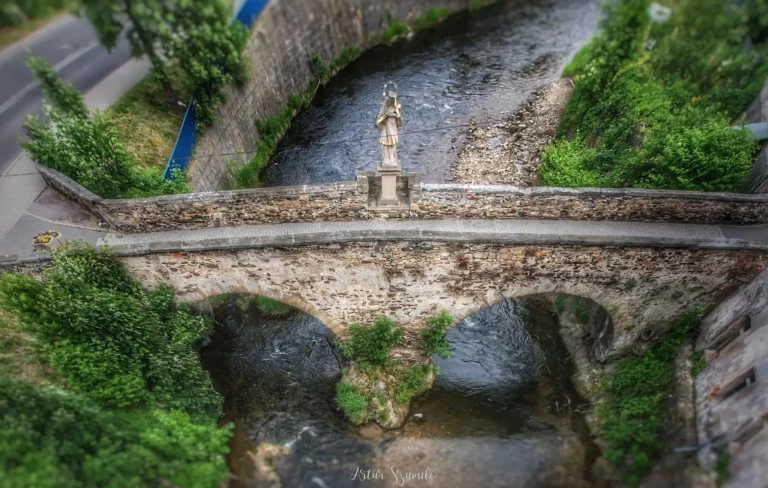
Gothic Bridge (St. John’s Bridge, Wit Stwosz Bridge)
The Gothic bridge on the Młynówka canal is one of the oldest bridges of its kind in Europe. Length: 52.5 meters, width: 5.70 meters.
Possible dates: 1281 or 1286 – sources disagree.
The bridge is decorated with six statues funded by residents in the 16th-18th centuries:
East Side: St. Francis Xavier (patron of the city), Christ on the cross, the Holy Trinity and the Coronation of the Blessed Virgin Mary
West Side: St. Wenceslas, Our Lady of Bolsna, St. John of Nepomuk
The bridge is older and similar to the Charles Bridge in Prague.
Church of the Assumption of the Blessed Virgin Mary
A Gothic parish church, built from the mid-15th century to the mid-16th century. Initiated by Archbishop Arnoszt of Pardubice.
Located in the Old Town, in Kościelny Square – the center of old Kłodzko.
Beneath the floor is the crypt of the Dukes of Ziębice.
Minieuroland – Miniature Park
A miniature open-air museum stretching over 20,000 square meters of famous world buildings – Dresden Zwinger, Arc de Triomphe in Paris, Kłodzko Fortress and many others.
Surrounded by over 500 species of trees and shrubs, imported from the best Dutch and Belgian nurseries.
Flower Festival: Every year on the last weekend of June – with over 70,000 annual flowers.
Museum of the Kłodzko Land
Founded in 1963, presenting the geology, geography, history, art and material culture of the region.
Located in the former Jesuit boarding school.
Largest collections: pewter, numismatics, Silesian clocks, artistic glass.
Fun Facts – History and Legend
1376 – Paved Streets Earlier than Paris
In 1376, Kłodzko already had paved streets – earlier than Paris. This is a testament to the city’s importance and wealth.
1850 – Last Execution
The last execution in Kłodzko took place in 1850 – the executioner beheaded a certain Treutler with an ax for the murder of a peasant from Drogosław.
1800 – Visit of the Future US President
In 1800, during a trip around Silesia, John Quincy Adams stayed in Kłodzko, who several decades later became the 6th President of the United States.
1398 – Florian Psalter
According to some sources, in 1398 the “Florian Psalter” was created in Kłodzko – one of the oldest monuments of Polish writing.
Kłodzko in TV series
1965: Episodes 18 and 21 of the series “Four Tank-Men and a Dog” were filmed in Kłodzko
1970: Part of the last episode of the series was filmed again in Kłodzko Fortress
<h2
Emil Czech – Hero of Monte Cassino
Emil Czech rests in the cemetery in Kłodzko, a Polish soldier who, on the day of the capture of Monte Cassino in 1944, played the Mariacki hejnał (St. Mary’s trumpet call) on the ruins of the monastery – a symbol of resistance and the Polish spirit.
The Kłodzko Hejnał
Every day at noon, the Kłodzko hejnał (trumpet call) sounds from the town hall tower – a tradition that has lasted for centuries.