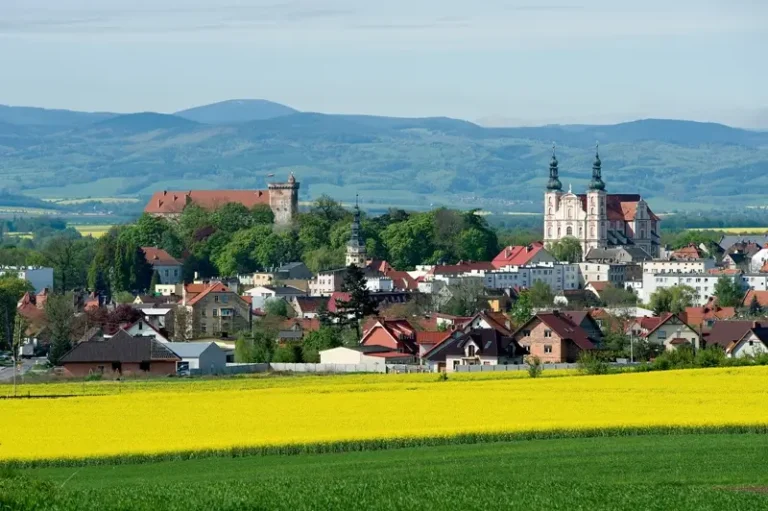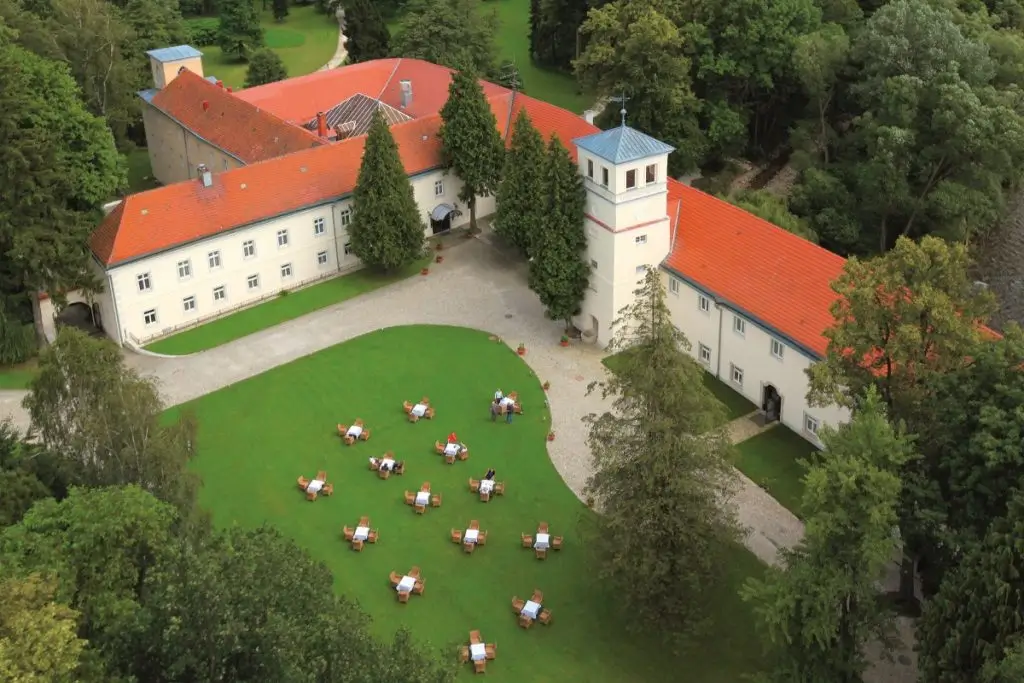
Castle on the Rock in Trzebieszowice is one of the most attractive and romantic monuments in the entire Kłodzko Land], and at the same time the most beautiful residence picturesquely located on the rocky bank of the Biała Lądecka River. This unique building, whose history is intertwined with episodes of European aristocracy, is now a luxury hotel with a full spectrum of modern amenities – from a SPA area, to a restaurant, to video mapping light shows. However, what really makes Castle on the Rock unforgettable is its rich, five-century history, a multi-layered history of various noble families, whose ambitions and dreams remained etched in every stone of this magnificent building.
History of the Castle – From Medieval Fortress to Renaissance Palace
Beginnings: A Knight’s Residence of the 15th Century
The documented history of Castle on the Rock dates back to the 15th century, a time when Poland, Germany, and the entire Silesia region were experiencing a turbulent era of medieval feudal conflicts. Originally, on the rocky and picturesque bank of the Biała Lądecka River], a knight’s residence was erected – a building with characteristic defensive features, built from a combination of wood and stone.
This medieval fortress served not only as a residence, but above all as a defensive point, controlling access to the river valley and trade routes. The knights inhabiting this fortress were small rulers – feudal lords who controlled the nearby areas, collected taxes from travelers and
they took care of the safety of their goods.
From those times, to our times, fragments of stone walls hidden in the castle cellars have survived – witnesses of centuries that speak of the building material of the time, the building technique, and the ambitions of medieval builders.
16th Century – The Birth of the Renaissance and the von Reichenbach Family
The breakthrough came in the 16th century, when medieval defense ideals were put aside in favor of Renaissance elegance and comfort. On the ruins and remains of the medieval fortress, the von Reichenbach family undertook an ambitious project – the construction of a new Renaissance manor.
The project stretched over decades – the construction of the manor was carried out in stages from 1550 to 1625, but the main structure of the building was completed in 1613. It was a transformative change – a defensive medieval complex was transformed into an elegant aristocratic residence.
A characteristic element of this Renaissance manor was the inner courtyard – an element typical of the Italian Renaissance, which showed the residence’s openness to art, light, and closer community within. This courtyard, initially uncovered, allowed social gatherings, receptions, and salon evenings to take place under the open sky.
The architectural complex of the manor received the name “Steinhof” – which in German means “Stone Manor” or literally “Castle on the Rock” – a name that has survived to this day and which we use to describe this object.
17th Century – The Era of the Wallis Family and Modernization
In the late 17th century, a new player appeared in the history of the Castle on the Rock – the Wallis family. These aristocrats, previously living in one of the Irish castles and with French roots, acquired the residence in Trzebieszowice and almost immediately began to rebuild it.
The modernization was most likely initiated by Georg Olivier Baron von Wallis (died in 1689). Under the direction of the Wallis family, the castle underwent radical transformations:
Change of Appearance from the River Side: The southern facade, facing the Biała Lądecka<button class="border-subtler group-active/language-learning:!bg-subtle inline-flex size-5 items-center justify-center rounded-full border shadow-sm outline-none border-subtlest ring-subtlest divide-subtlest bg-raised
który [
], has been rebuilt in a new, more representative wayReconstruction of the Main Village Road: New entrances and gates were the first perception for guests arriving by land
New Economic Structures: A new part of the castle was built containing stables and a two-story orangery on the first floor (a winter garden for growing tropical plants)
Castle Tower: A new tower was built, which dominated the landscape and served both a defensive and representative function
The Wallis transformations gave the castle a look reminiscent of Eastern European magnate palaces – representative, magnificent, a testament to wealth and influence.
18th and 19th Centuries – The Era of Apogee and European Fame
In the 18th and 19th centuries, Castle on the Rock became one of the biggest attractions of the Kłodzko Land. Its reputation grew, and not only local nobility came to the castle, but tourists from all over Europe – merchants, travelers, aristocrats from France, Germany, Austria, and even from more distant countries.
Visiting the Castle on the Rock became particularly popular among patients coming to the nearby Lądek-Zdrój, a famous health resort. The castle became an additional attraction on tourist routes – a place that had to be seen to make your stay in the region genuinely valuable.
The castle played the role of an aristocratic center of the region – a place where the elite stayed, where balls, receptions, concerts and social gatherings took place. The history of the castle was the history of its contemporary times – the era of the Napoleonic wars, the era of industrial revolutions, the times of the Enlightenment.
1813 – Royal Birthday and Meeting of Monarchs
The culminating moment of the political significance of the Castle on the Rock was the year 1813, an episode that will still resonate in the memory of history. In that year, an unusual guest appeared – Prussian King Wilhelm III, accompanied by his family and a large retinue. He arrived in nearby Lądek-Zdrój] as a spa guest, but his stay took on political dimensions.
Very soon after arriving in Lądek-Zdrój, another powerful monarch joined the king – Russian Tsar Alexander I. These two powers – Prussia and Russia – were soon to meet on the Napoleonic battlefields, but in the summer of 1813 they found themselves together in the mountains of Silesia.
Wilhelm III decided that he would celebrate his birthday at the Castle on the Rock in Trzebieszowice. It was an extraordinary honor for the castle – two European monarchs, who shaped the fate of the continent, chose this place for the celebration. It was a witness to a breakthrough moment in history – just a year after Napoleon’s abdication.
This royal visit cemented the legend of Castle on the Rock] in the minds of the European aristocracy – the castle, which the Tsars visited – was a place where great historical episodes took place.
Beginning of the 20th Century – The Last Great Reconstruction
At the turn of the 19th and 20th centuries, the castle underwent its last significant reconstruction. This time, the patrons of the changes were the French Chamare-Harbuval family, who took over the estate after the Schlabrendorf family. The reconstruction took place in the years 1903–1905 and was motivated by the ambition to create a modern residence combined with parks and viewing axes.
Reconstruction Philosophy:
The main driver of the last great transformation were plans to create magnificent viewing axes – visual lines that would guide the guest’s gaze from the palace to the park, from the park to the river, from the river to the village, from the village to the surrounding hills. This was a European tradition – creating harmony between architecture, nature and landscape.
Castle Park – A World-Class Arboretum
One of the greatest treasures of Castle on the Rock is the surrounding castle park, which architects of the 18th and 19th centuries created with great piety and artistic vision. This park is one of the most interesting park layouts in Silesia, full of exotic species of trees and shrubs that reflect the European penchant for botany and horticultural experiments.
Monumental Trees – Living Treasures
In the park of the Castle on the Rock there are many monumental specimens of trees and shrubs, which have survived for over a hundred years and are living witnesses of the past:
Twenty-meter Japanese Cypresses – exotic specimens that have acclimatized incredibly well in the Silesian climate
Nearly Two Hundred Year Old Siberian Spruces – powerful conifers with a trunk circumference of over two meters
Equally Old Maples and Sycamores – European dendrological classics that grow to full size
Gigantic White Pines – American pines that were once a must-have for European parks
Difficult to Cultivate Bald Cypress – an exotic plant whose successful cultivation is a sign of the castle gardeners’ skills
Black Pine – another exotic species, adding variety
Japanese Ginkgo – a rare variety of Ginkgo biloba, a species that lived alongside dinosaurs
Other Rare Varieties – whose names and origin are a separate story of botanical collectors
A walk through the park is a journey through European botany and the history of gardening – you can see how European elites at the turn of the 19th and 20th centuries were interested in exotic plants, how they imported them, how they tried to acclimatize them in their homeland.
Architectural Highlights – Staircase, Courtyard and Residential Elegance
Wooden Staircase – A Work of Baroque Art
One of the most attractive elements of the castle, which attracts the attention of every visitor, is the richly carved and extremely decorative wooden
staircase. This construction is inspired by the style of Viennese Baroque – an architecture that combines classicism with ornamental exuberance.
Every step, every baluster, every element of this staircase is a reflection of the artistic ambitions of the architects and the unpeopled who worked on this structure. The wood used in its construction was of the highest quality – hard, durable wood selected from Central and Northern Europe.
Inner Courtyard – A Stage for the Drama of History
The castle’s inner courtyard is a characteristic element of the Renaissance – an open space surrounded by walls, serving as the castle’s lungs. Over the centuries, scenes of history have unfolded in this courtyard – balls, receptions, councils, ceremonies, but also the everyday life of the people inhabiting the castle.
The courtyard was also a practical architectural solution – enabling air circulation, providing light to the inner chambers, and serving as the setting for adjacent rooms.
Contemporary Role – SPA Hotel and Tourist Attraction
Today, Castle on the Rock houses a luxury four-star hotel – an adaptation of a historical object for the contemporary needs of tourism and hospitality.
Hotel – Comfort and History in Harmony
The hotel, operating under the official name Hotel Zamek na Skale, offers:
Rooms of various categories: From standard, through superior, to de luxe apartments
Restaurant: Serving both traditional Silesian cuisine and international specialties
SPA and Wellness Zone: Featuring swimming pools, sauna, jacuzzi, and rooms for relaxation treatments
Conferences and Events: The castle is a popular place for organizing business conferences, weddings, and corporate events
Videomapping – A Modern Tale of the Past
A particularly unique attraction is the new 3D videomapping installation, which is displayed in the evenings on the walls of the inner courtyard.
Mapping Characteristics:
Technique: Modeling 3D graphics by superimposing a two-dimensional image
na trójwymiarowe ścianki i obiekty architektoniczne zamku
Narrative: The main axis of the narrative is the history of the castle over five centuries – from a medieval knight’s seat, through a Renaissance court, to the present day
Composer: The music for the mapping was composed by the well-known Polish composer Józef Skrzek – winner of the prestigious Fryderyk Award in 2013
Animation: Made by Błażej Krajczewski, a specialist in modern 3D visualizations
Length: The entire animation lasts 9 minutes and is a complete story
Evenings at the Castle on the Rock, when the videomapping is displayed, have something of theatricality about them – the bones of the castle come to life, the architecture speaks, history can be *seen* live.
Live Music – Enhancing the Atmosphere
In addition to videomapping, concerts of live music are held in the castle courtyard – from classical to jazz to contemporary music. This makes the castle not only a place to visit, but a place of sensory experiences.
Visiting the Castle – Practical Information
Access and Opening Hours
Address: Trzebieszowice 151, Lądek Zdrój
Phone: 74/865-20-00, 888-010-555
Email: zamek@zameknaskale.com.pl
Website: www.zameknaskale.com.pl
Visiting Hours: Daily from 10:00 AM to 5:00 PM (with a guide)
Open 24/7: The hotel is open all the time for hotel guests
Tickets and Prices
Regular Ticket: 18 złoty
Discount Ticket (students, pensioners, children): 12 złoty
Night Tour: A popular experience is visiting the castle in the evening when architectural lighting and video mapping are turned on – this offers a completely different perspective on the monument.
Hotel Packages
The hotel offers various stay packages:
Accommodation with Breakfast: A comfortable stay with breakfast served in the restaurant.
Access to SPA: All guests receive free access to the SPA & Wellness area (small pool, jacuzzi)
Conference Packages: Special offers for business groups
Wedding Packages: The castle is a popular place for weddings and receptions
How To Get There
By car from Wrocław: Approximately 2–2.5 hours (approx. 180 km), road through Nysa, Kamień, Stronie Śląskie, then to Trzebieszowice.
By Train: To Kłodzko or Stronie Śląskie, then taxi or private transport
From Lądek-Zdrój: Just a few kilometers – you can even walk (about a 30-minute walk)
The Legend of the Castle – Atmosphere and Genius Loci
Castle on the Rock is not just an old building – it is a living organism full of spirit. The history that took place in this place for five centuries is practically palpable. Each corridor bears traces of someone who stayed here – whether it was a medieval knight, an aristocratic lady of the 18th century, or spirits from the Napoleonic wars wandered here.
The contemporary adaptation of the castle as a SPA hotel shows that the old does not have to die – it can live on, serve new generations, be a source of income and a tourist spot. History and modernity find harmony.
The castle takes on a particularly magical atmosphere in the evenings, when:
The sun sets behind the mountains surrounding the valley
Architectural lighting illuminates the facade
Videomapping brings the walls to life with history
The music of Józef Skrzek carries through the courtyard
Guests sit with glasses of wine, listening to live concerts
It is then that one feels that the past and present have met in perfect harmony.