Bear Cave is undoubtedly one of the most attractive underground natural wonders on the entire European continent. Located in the heart of the Śnieżnik Massif, in the picturesque valley of Kleśnica near the village of Kletno, this unique cave attracts tens of thousands of tourists from all over Poland and abroad every year. It is the longest cave in the entire Sudetes – on both the Polish and Czech sides – and its history of geology, archeology and tourism dates back almost 60 years, since it was accidentally discovered in 1966. Today, Bear Cave is the main attraction of Kłodzko Land, an irreplaceable point on the map for every nature, paleontology and adventure lover on a journey through the space-time of 50,000 years ago.
Discovery Story – A Coincidence That Changed Everything (1966)
The history of Bear Cave is a story of a happy accident. On October 14, 1966, workers working in the marble quarry called “Kletno III”, belonging to
of the Bystrzyca Stone Building Plant, which extracted marble using the open-pit method, suddenly revealed the entrance to underground chambers.
Discovery of the Entrance Opening
The entrance opening to the cave was in the shape of a horizontal fissure, located about 2 meters above the level of the then marble quarry. Workers – perhaps intrigued by this opening – went inside and found themselves in a previously unknown world – a world of underground halls, corridors and mineral formations. But the most interesting thing was what they found inside – the remains of mammals, especially bones of what was identified as a cave bear.
Suspension of Exploitation – A Decision Ensuring the Preservation of the Cave
Extremely important for the future of the cave was the fact that, due to the extraordinary natural value of this discovery, further marble extraction in this particular quarry was stopped. This decision – a decision protecting the cave from destruction – resulted in the fact that today we can admire this extraordinary place in its natural state.
Extended Explorations – From Small Fragments to Gigantic Halls
After the initial discovery in 1966, the exploration of the cave continued for many years. Scientists and speleologists (scientists studying caves) systematically explored and mapped successive parts of the cave.
A particularly important moment came on December 3, 1967, when a team of speleologists consisting of A. Piesiewicz, M. Pulina, T. Wiszniowska and G. Ziembicki discovered the Palace Halls and the Corridor of Primitive Man with adjacent corridors. This discovery changed the known dimensions of the cave from the initial hundreds of meters to over 350 meters of known fragments, and ultimately to today’s almost 5 kilometers!
Nature Reserve (1977)
In 1977, eleven years after the discovery of the cave, a reserve was established around it, which protects both the local forest and the cave itself. This is an official recognition of the value of this place.
Opening for Tourism (1983)
It was not until 1983 that the cave was opened for tourist visits. This meant that for 17 years after the discovery, scientists studied the cave, consolidated the route, and prepared the infrastructure. This is a long time, but time necessary to prepare the cave to safely welcome tourists.
From 1983 until today, Bear Cave remains open to the public and attracts tourists every year.
Cave Bear – Giant of the Ice Age and Cave Mythology
The name of the cave comes directly from the remains found in it – from the bones of cave bears, extinct giants who inhabited Europe during the last ice age.
Cave Bear Parameters – Beast of the Pleistocene
The cave bear (Ursus spelaeus) was absolutely the most powerful beast –
the most powerful predator of the Ice Age in all of Europe. Its parameters are staggering:
Height at the withers: up to 1.5 meters (almost twice as tall as a modern brown bear)
Body length: up to 2 meters
Weight: up to 1000 kilograms, i.e. up to 1 ton
Temporal Range of Existence: Lived approx. 300,000 years ago and became extinct at the end of the last ice age, approx. 28,000 years ago
To imagine how huge the cave bear was – a modern brown bear weighs about 400-700 kg, and the cave bear often exceeded that twice! It was an animal that even primitive man, despite having tools and weapons, had to flee from.
Cave Bear Diet – Herbivore, Not Carnivore
An interesting discovery by researchers – contrary to the name “cave bear”, this beast in particular was almost completely herbivorous, not a predatory carnivore. The structure of its teeth (especially molars) indicates an adaptation to chewing plants, not chewing meat. Only occasionally – in the absence of other food – did it feed on animal proteins.
This means that the giant, who hid in caves from the cold and frost, spent most of its time hunting for plants, leaves, roots – food that was less spectacular, but sufficient to maintain the snow-covered monster.
Behavior: Hibernation in Caves
The cave bear often lived in caves, and retreated to caves to survive the harsh conditions of the Ice Age and go into hibernation. The Bear Cave in Kletno was one of many shelters used by these animals. Sometimes, however, the animals did not wake up from hibernation – they died there and remained there for centuries as bones waiting for future scientists.
Primitive Man Hunts the Bear – Testimony of Violence
One of the most tragic discoveries is the proof that Paleolithic man hunted cave bears. On one of the bear skulls found in the cave, characteristic traces of a blow from a human hand armed with a tool were found. These were blows – brutal proof that man, being physically weaker, compensated for it with intelligence and weapons.
However – and this is interesting – no human remains were found in the cave. Perhaps Paleolithic man had a custom of burying his dead elsewhere, or – more likely – the remains disintegrated over tens of thousands of years.
Exhibition in the Pavilion – Complete Bear Skeleton
In the entrance pavilion to the cave, every tourist – even those who do not enter the cave itself – can see a paleontological exhibition for free. The mainthe exhibit is a complete skeleton of a cave bear, a reconstruction that allows one to imagine the appearance of this gigantic animal.
Looking at this skeleton, I understand why primitive man needed tact, cunning, and collective hunting strategies to resist such beasts.
Other Faunistic Findings – The Pleistocene Ecosystem
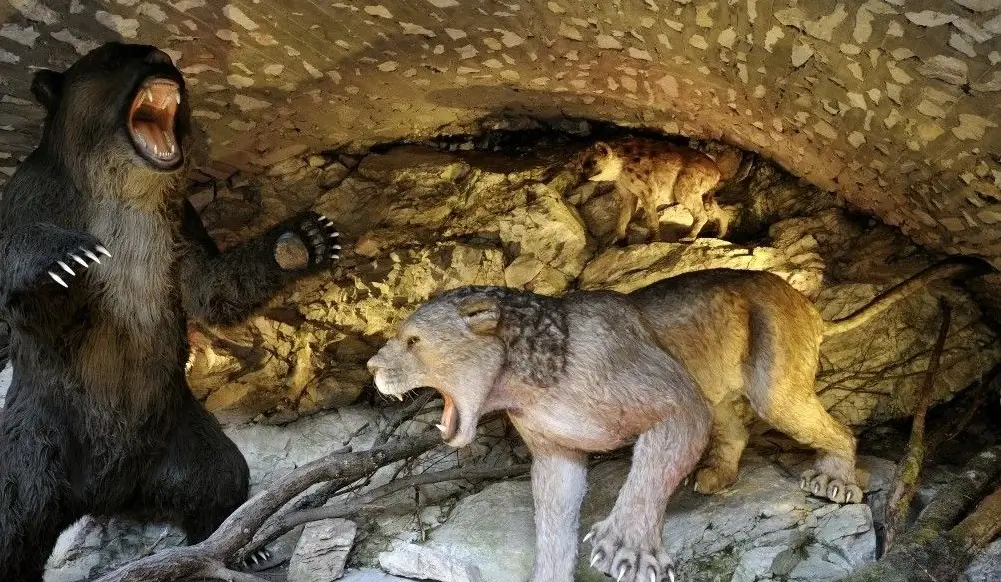
In addition to cave bears, the remains of many other Pleistocene animal species were found in the Bear Cave:
Cave Hyena – a predator with enormous bite force, hunting megafauna
Cave Lion – which was as dangerous as the cave bear, perhaps even more so
Wolf – the ancestor of the modern dog, but much less adapted to living in a pack
European Bison – European bison, similar in size to today’s
Horse – an extinct species, much smaller than the modern domestic horse
The remains found indicate that the cave was witness to dramatic scenes – scenes of hunts, death, natural processes of decay and fossilization.
Speleothems – Nature’s Mineral Artwork
However, what Bear Cave is most famous for is not the remains of prehistoric animals, but its stunning speleothems – a wealth of natural mineral formations that have formed over millions of years.
Conditions for Speleothem Formation – Temperature, Humidity and Water Flow
Ideal conditions for creating unique speleothems are the result of:
Constant Temperature: Approx. 6°C all year round – this is a cold ideal for maintaining the stability of mineral deposits
100% Humidity: The air in the cave is absolutely saturated with moisture – this is necessary for the process of evaporation and calcium deposition
Weak Air Movement: The absence of winds allows for the harmonious descent and flow of water containing minerals.
These three conditions together create the ideal environment for the formation of spectacular dripstones.
Dripstone Forms – Gallery of Nature
In Niedźwiedzia Cave you can see practically all forms of dripstones typical of karst caves:
Stalactites and Stalagmites – Classic forms:
Stalactites hang from the ceiling (remember: “tite” is tight to the ceiling)
Stalagmites grow from the floor (remember: “might” reach the top)
They are decorations of a natural underground “church”
Macaroni – Thin Dripstone Tubes:
Also known as soda straws, they are formed from droplets seeping from the rock. Water containing calcium carbonate slowly deposits sediment, creating increasingly thinner tubes – sometimes only the thickness of a hair, sometimes stronger like a small ring.
Stalagmates – A Combination of Stalactites and Stalagmites:
When a stalactite growing from above meets a stalagmite growing from below, stalagmates are formed – formations connecting heaven and earth.
Draperies – Mineral Pendants:
The water falls not vertically, but diagonally, creating the effect of suspended curtains – draperies.
Fungus Dripstones – Umbrella-Shaped Forms:
When the dripstone grows slower from the side than from above, an “umbrella” effect is created – wide caps hanging from the ceiling.
Tufa Bowls – Mineral Pools:
Shallow pools filled with mineral-containing water form at the bottom of the cave. The bottom of these bowls is still being formed by calcite urchins – small, sharp crystals that look like coral.
Calcite Flowers – Crystals on the Water Surface:
Most amazing – crystals of calcite are formed on the surface of the water in the bowls, which look like flowers floating on the water. These are ephemeral structures that can be destroyed by any wave, so tourists are asked not to touch the surface of the water.
Forms Resembling Coral Reefs – Biogenic Structures:
In the deepest pools, formations resembling coral reefs were formed – sharp, plant-like mineral structures.
Rice Fields – Microscopic Formations:
On certain surfaces, mineral formations the size of rice grains are formed – this is the effect of a very slow calcium deposition process.
Visiting Routes – From Tourist to Extreme
<spanBear Cave offers two completely different sightseeing routes – for different levels of experience and willingness to adventure.
Tourist Route – Standard for the Motorized
The tourist route is a standard route, available to everyone, regardless of age or physical fitness:
Prepared for Tourists with Children: The path is quite well leveled and safe
No Tight Gaps: There are no sections requiring squeezing through narrow passages
Well Lit: The route is equipped with electric lighting, which makes it safe and allows for the full realization of dripstones
Length and Time: The tourist route is about 1.5–2 hours of guided tour
Accessibility: Elderly people, people with wheelchairs (with certain limitations) can enter here
Extreme Route – For the Brave and Slim
For those who want a more authentic experience and are looking for adrenaline, Bear Cave offers an extreme route:
Characteristics:
Only for the Brave: This is not a route for everyone – it requires considerable climbing skills and proficiency in orientation
Requires Slenderness: In places, the cracks are so tight that a thicker person may have problems passing through
Protective Overalls: On site, each participant receives protective overalls – because be prepared to get dirty
Route Length: About3 hours of intense adventure
Depth: The route descends to lower, lesser-known parts of the cave.
Extreme Character: The route has more dangerous sections, constrictions, passages requiring climbing and scrambling
Guide Mandatory: You always have to be under the care of an experienced speleologist guide
Thrill of Adventure: This is a place for speleologists (people professionally exploring caves) and for amateurs looking for something beyond a standard tourist experience.
Museum of the Earth in Kletno – Supplementing the Experience
For tourists visiting the Bear Cave, it is also worth planning a visit to the Museum of the Earth in Kletno, which is located near the cave. The museum contains exhibits of minerals, fossils and the geological history of the region – expanding the educational value of the visit.
Practical Information – How to Plan a Visit
Location and Access
Address: Kletno 18, Stronie Śląskie
Altitude: Approx. 800–807 meters above sea level
Access on Foot: From the parking lot (at the Museum of the Earth) about 20 minutes walk
Parking: Paid parking near the Museum of the Earth
How to Get from Wrocław:
By car, about 2–2.5 hours (approx. 180 km). The road through Nysa, then to Stronie Śląskie, then to Kletno.
Opening Hours and Seasons
Not Open Every Day: The cave has limited opening days
Reservation Required: Places are limited, you need to book tickets in advance
<li class="py-0 my-0
Current Information: It’s best to check the official website jaskinianiedzwiedzia.pl
Entrance Fees
Tourist Route: Usually 50–60 złoty for adults
Extreme Route: Higher price, usually 100–150 złoty (due to more extensive guide supervision)
Children: Usually reduced prices
Equipment and Safety
Helmet and Flashlight: Provided by the operator
Footwear: Comfortable, trekking shoes required
Clothing: Warm – the temperature in the cave is about 6°C
Bag: Minimal portion – it is better to leave your backpack in the parking lot
Guides
Visiting always takes place with an experienced guide. This is mandatory for safety reasons. The guides know every part of the cave and can share interesting facts about its history and geology.
Scientific Significance – Bear Cave in the Context of European Research
Bear Cave is not only a tourist attraction – it is also a local point of reference for scientists from all over Europe. The remains found in the cave have contributed to understanding:
Climatic Fluctuations of the Pleistocene
Ecosystems of the Ice Age
Paleolithic Human Behavior
Evolution of Animal Species in Response to Environmental Changes
The cave remains the subject of ongoing research and discoveries – scientists may still find new parts of the cave, new remains or new mineral forms.