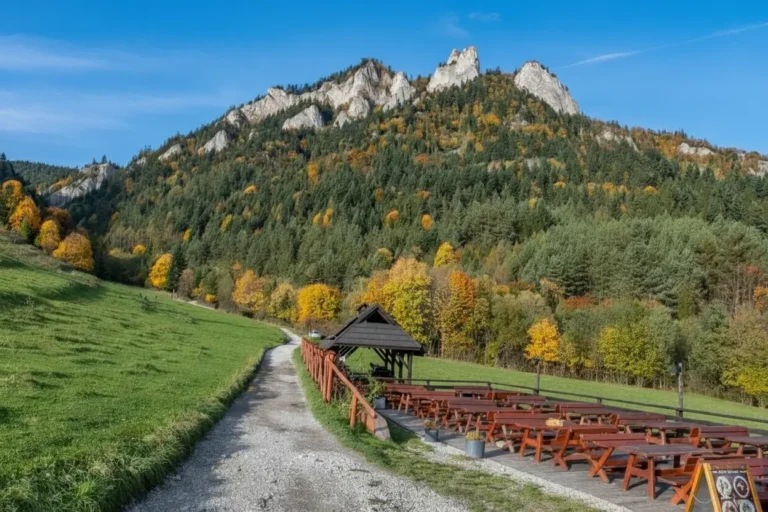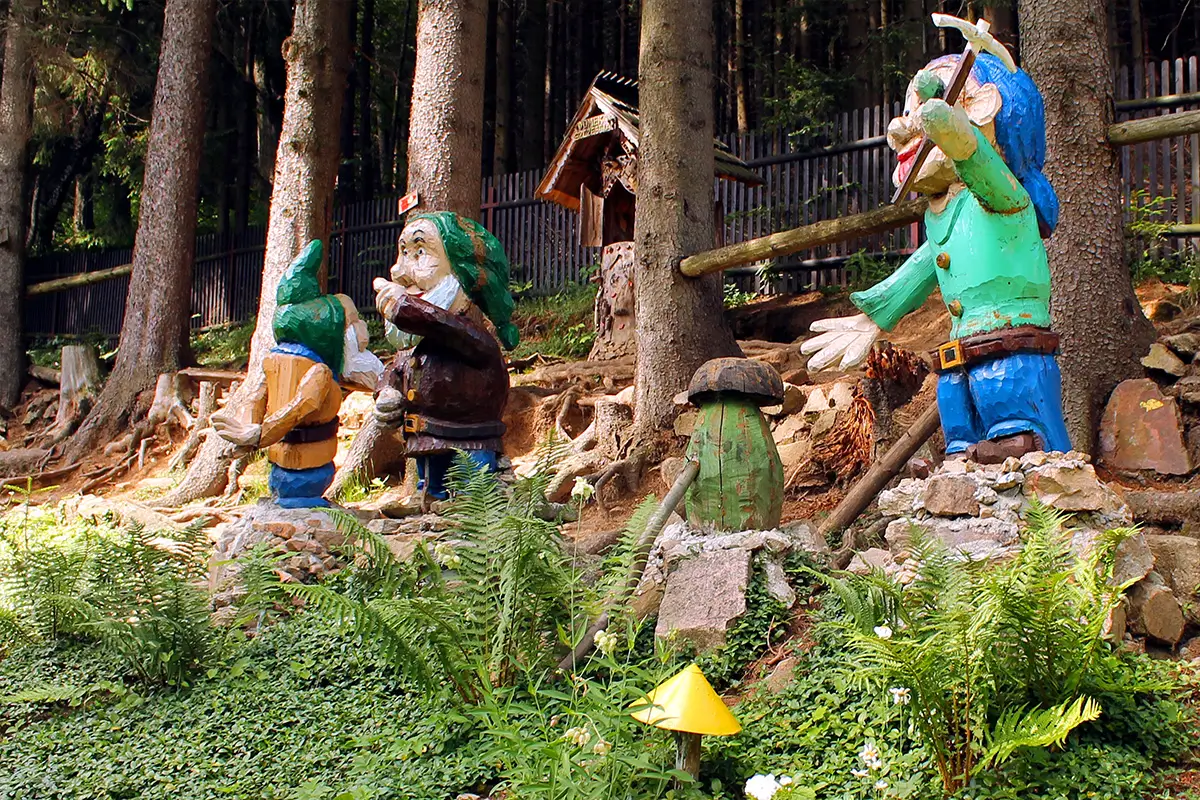
The Garden of Tales is one of the most unique and attractive places in Międzygórze – a picturesque open-air museum located on the steep slope of Lesieniec Mountain, in the depths of the forest, where wooden fairytale characters, carved from roots, sticks, and wood, await tourists coming from all over the world. It is a place that particularly attracts families with children, although its charm is also appreciated by adults – people looking for nostalgia for childhood fairy tales, recalling Pinocchio, Baba Yaga, Koziołek Matołek (a popular Polish cartoon character), or Koszałek Opałek (another popular Polish cartoon character). The history of this extraordinary garden dates back to 1920, when forester and botanist Izydor Kriesten decided to create a living monument to fairy tales, legends, and the mythical Spirit of the Mountains – Rübezahl. For almost a hundred years, through numerous twists of fate and neglect, the Garden of Tales has survived to this day as a testament to human creativity, faith in the power of fairy tales, and dedication to the art of root sculpture – a sculptural art created from natural forest materials.
History – From Tribute to the Spirit of the Mountains to a Modern Open-Air Museum
1920 – Izydor Kriesten and the Legend of the Spirit of the Mountains
The history of the Garden of Tales begins immediately after World War I, at a time when Silesia was undergoing dramatic political and social changes.
Izydor Kriesten – an ordinary forestry worker, a man in love with nature and fairy tales – decided to create something unique. He built himself a house in Międzygórze, on the slope of Lesieniec, surrounded by forests, where he began to collect wooden sculptures.
According to legend, Kriesten wanted to pay tribute to the mythical Spirit of the Mountains – Rübezahl – who – as the stories say – saved his life in some dramatic circumstances. We don’t know exactly what happened, but this tribute took the form of an extraordinary artistic endeavor.
Root Sculpture – The Art of Carving Roots and Wood
What made the Garden of Tales unique was the artistic technique that Kriesten used – root sculpture.
What is Root Sculpture?
Root sculpture is an art of sculpture in which the artist uses natural forest materials – roots, trunks, branches, pieces of wood – instead of carving or sculpting them from scratch. It is the art of finding the shape in nature, not just creating it.
Imagine an old hollowed-out stump that has natural depressions, bulges, ramifications. The artist looks at this stump and sees – let’s say – the face of Baba Yaga. Improving here, covering up there, adding a piece of root here – the creation from nature turns into a character from a fairy tale.
Such a sculpture is not completely artificial – it is a symbiosis of nature and human imagination.
About 20 Years of Work – A Monumental Project
Kriesten worked on this project for about 20 years – from the mid-1920s. These were years of intense work – searching for materials in the forest, cleaning roots, carving, pulling out, setting up.
Gradually, over time, a collection of sculptures gathered – more and more characters, more and more complex works. The garden underwent a transformation – from an empty forest clearing into a fantastic kingdom of fairy tales.
Name – „Garden of Tales“ Given by the People
<p
The locals, looking at this extraordinary place, gave it the name – „Fairy Tale Garden“. This name, although simple, perfectly reflected the nature of this place. The name stuck to it and has survived to this day.
After 1960 – Degradation and Oblivion
After Izydor Kriesten’s death – or perhaps earlier, as he was getting old – the Fairy Tale Garden began to fall into disrepair.
After 1960, when Międzygórze was undergoing a transformation in communist Poland, the garden fell into oblivion. The sculptures rotted, the vegetation overgrown, the paths overgrown with bushes. What Kriesten had built with dedication gradually turned into a ruined place that did not attract tourists or local residents.
Scouts in the 70s – Short Revitalization
In the 1970s, scouts took care of the garden. These were enthusiasts who saw the value of this place and undertook to save it. For several years they kept it tidy, renovated sculptures, and cleaned paths.
However, their involvement was limited – in 1981, the scouts withdrew from taking care of the garden, probably due to lack of funds, changes in the structure of the organization, or simply a lack of possibility to continue their involvement.
The garden fell into disrepair again.
1985 – Breakthrough – PTTK Takes Over Care
In 1985, a breakthrough occurred. The PTTK (Polish Tourist and Sightseeing Society) branch in Międzygórze decided to take over the care of the Fairy Tale Garden.
It was a decision that would change the fate of this place forever.
1986 – Great Renovation
On September 14, 1986, the Fairy Tale Garden was officially reopened to tourists.
What did PTTK change?
-
New Fence – protection against intruders
-
Retaining Walls – protecting the area from landslides
-
Roofed Houses – beautiful structures covered with shingles, resembling fairytale cottages
-
Numerous Ornamental Trees and Shrubs – new greenery, rejuvenating the garden
-
Miniature Tower from Śnieżnik – a stone replica of the famous observation tower from the summit of Śnieżnik
-
<p class="my-2 [&+p]:mt-4
Wooden Plaques with Aphorisms – written by Czesław Zawojski, adding humor and wisdom
Subsequent Years – Discoveries of New Sculptures and Modernization
In subsequent years, especially under the leadership of Jerzy Drążkowski (a member of PTTK) and Czesław Zawojski (a sculptor), the Garden was gradually supplemented with new works.
In 2008, a thorough renovation of all sculptures was carried out, giving them a new colorful attire.
In 2009, the „Gnome Trail“ was opened – a tourist path leading from the bus stop to the Garden, which significantly increased the accessibility of this place for tourists.
Fairy-Tale Characters of the Garden – Who Lives in the Forest?
In the Garden of Fairy Tales, you can meet characters from old Polish and world fairy tales, as well as contemporary animated films. Here are the main „residents“:
Classic Fairy Tale Characters
-
Wawel Dragon – carved from roots, welcoming guests at the entrance
-
Pinocchio – a wooden boy, a symbol of hope
-
Hansel and Gretel – siblings from the German fairy tale by the Brothers Grimm
-
Baba Yaga – a witch from Russian fairy tales, in her mortar
-
Gargamel and Azrael – characters from the Smurfs, animation classics
-
Matołek the Billy-Goat – a Polish fairy tale, loved by generations
-
Koszałek Opałek – a littering character from Polish folklore
-
Puss in Boots – a picaresque fairy tale hero
Contemporary Characters
The garden has not stalled on the past – characters from contemporary fairy tales and films are successively added:
-
Shrek – an ogre from the popular DreamWorks animated film
-
Peppa Pig – character from an animated series for the youngest viewers
-
Spider-Man – Marvel superhero
-
And many others…
-
Rübezahl – The Mountain Spirit – a mythical figure to whom Kriesten paid homage
-
Snow White’s Cottage – a charming cottage from a fairy tale
-
House of Happiness – a symbol of joy
-
House of Love – a place for reflection
-
Enchanted Springs: „Of Delight“ and „Of Youth“ – where the water tastes magical for the youngest
-
Location: On the slope of Mount Lesieniec, surrounded by forests
-
Altitude: 700–780 m above sea level
-
Area: Approximately 0.25 hectares
-
Leads from the center of Międzygórze
-
Easy, accessible to everyone, even young children
-
Leads through the Wilczki Waterfall
-
More difficult, but offers spectacular views
-
Recommended for older and more enduring hikers
-
In the spring of 2009, the Dwarf Tourist Trail was opened, leading from the bus stop in Międzygórze
-
Specially designed for guests heading to the Garden
-
Accessibility: Generally accessible and free of charge
-
Hours: There are no set hours – the garden is accessible from sunrise to sunset
-
Facilities: No restaurants or shops – it’s worth taking provisions
-
Spring: When plants start to bloom – the garden becomes even more magical
-
Summer: Full of greenery, warm days perfect for a walk
-
Autumn: Golden colors of the leaves create unforgettable views
-
Winter: In the snow, the garden takes on a fairytale look, although access is more difficult
<li class="py-0 my-0 prose-p:pt-0 prose-p:mb-2
Mythical Figures
Fairy-tale Houses and Places
In addition to the sculptures, the garden features:
Infrastructure and Tourist Experience
Location and Access
How to Get There
Yellow Trail – Easiest (30 minutes)
Red Trail – More Demanding (45 minutes to 1hours)
Dwarf Trail – Newer (about 20 minutes)
Opening Hours and Fees
Best Time to Visit
The Garden’s Unique Role – Educational and Spiritual
The Garden of Tales is not just a tourist attraction for children. It’s also:
A Place of Reflection: Adult tourists are charmed by the nostalgia for their own childhood – the word of Koziołek Matołek, the image of Baba Yaga, the smile on Pinocchio’s face
<p class="my-2 [&+p]:mt-4 [&_strong:has(+br)]:inline-block
Educational Source: For children – a meeting with the world of fairy tales, stimulation of imagination, a combination of literature and art
Artistic Work: The root sculpture of Izydor Kriesten and contemporary artists shows how nature can become a medium for human creativity
Collective Effort: The history of the Garden is also a story of how a community (Scouts, PTTK, artists) can save valuable, endangered places.