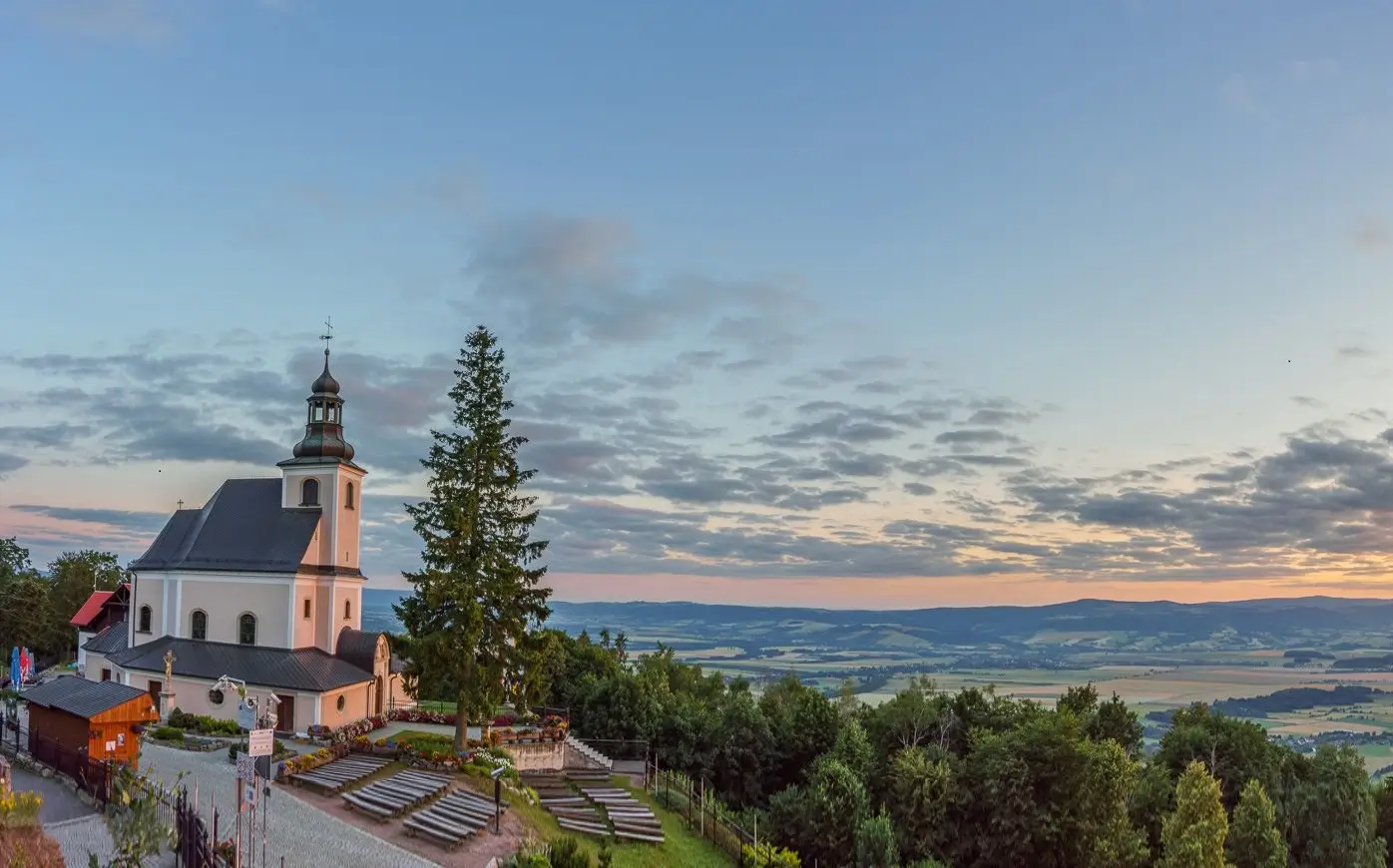
The Sanctuary of Our Lady, Cause of Our Joy “Mary of the Snows” is one of the most striking and famous pilgrimage sites in all of Poland – a small but monumental late Baroque church located beneath the peak of Mount Igliczna (845 m a.s.l.) in the heart of the Śnieżnik Massif. The history of this place is a story of miracles, faith, and human fortitude that defies unfavorable fates – it is a story of a figurine that survived a hurricane, of children who had their sight restored, of hands crushed by machines and miraculously repaired. Here, in 1983, Pope John Paul II – who visited this sanctuary twice as Bishop Karol Wojtyła in 1961–1968 – crowned the figurine of Our Lady of the Snows, ultimately recognizing this place as a global Marian shrine. Today, the Igliczna Sanctuary attracts not only pilgrims seeking spiritual graces but also tourists seeking beauty, contemplation, and panoramic views of the Kłodzko Land.
History – From Austrian Souvenir to Polish Sanctuary
1742 – Division of Silesia and Genius of Faith
To understand how the Sanctuary on Igliczna was created, one must go back to the 18th century – to the times when Silesia was divided between rival European powers.
Before 1742, Silesia belonged entirely to the Austrian Habsburg monarchy. The people of the Kłodzko Land, seeking spiritual graces and health, made pilgrimages to the famous Austrian shrine of Mary in Mariazell (also called Maria Zell, in Styria, today in Austria).
Mariazell was one of the oldest and most famous Marian shrines in Europe – the Madonna here was revered as the “Mother of the Slavic Nations”. Pilgrims came from all over Central Europe, seeking health and graces.
However, in 1742, as a result of the First Silesian War, the situation changed completely. Silesia was divided – most of the territory, including the Kłodzko Land, was taken over by the Prussian Crown of Frederick the Great.
Suddenly, the people of the Kłodzko Land found themselves in the Prussian sphere of influence, while what they had been pilgrimaging to – Mariazell – found itself in the Austrian sphere. The Austrian-Prussian border became an impenetrable barrier – crossing it without special permits was impossible.
This was a tragedy for the faithful – they lost access to the temple they had revered for generations.
1750 – Krzysztof Veit Brings a Souvenir
However, faith found a way. In 1750, a resident of the village of Wilkanów, Krzysztof Veit, decided to do something bold – he went on a pilgrimage to Mariazell himself, despite the risks associated with crossing the border.
Upon his return, he brought with him a folk copy of the figurine of the Mother of God from Mariazell – made of linden wood. It was a replica, but for the people of the Kłodzko Land, it was everything – a connection to what they had lost.
Krzysztof Veit placed the figurine on an old beech tree growing on the slope of Mount Igliczna – on land that belonged to his family. It was supposed to be a simple souvenir, nothing more – a way for people to remember the Austrian shrine.
No one was thinking about building a sanctuary at that time.
1765 – Storm and Miracle
<p class="my-2
However, fate had other plans. Fifteen years later, in 1765, a huge storm hit Wilkanów and the surrounding area.
The storm overturned roofs in the village, destroyed trees, and raged with fury. It also collapsed the old beech tree on which the statue of the Mother of God was hung.
When Krzysztof Veit and his brothers took the statue out from under the fallen tree, they made an incredible discovery – the statue was not damaged, it didn’t even have a scratch.
This was considered a miracle.
For the people of the Kłodzko Land, this was a clear message – God wants a temple to be here, on this mountain. The call came from the heavens themselves – through the undamaged statue.
The statue was moved to another, safer place – more sheltered from the storms.
1776–1777 – Construction of the Chapel and First Miraculous Healings
In 1776, the first wooden chapel was built in the place of the current presbytery. It was a simple, small place of prayer – but its significance was enormous.
Never succumbed to what people from all over the Kłodzko Land come, seeking the help of the Mother of God.
And then something happened that changes everything.
June 26, 1777 – First Approved Healing
On June 26, 1777, just a year after the chapel was built, the first official, miraculously healing, confirmed by the church commission was recorded.
The Story of the Boy from Sienna:
The son of Wawrzyniec Franke from the village of Sienna (a few kilometers from Igliczna) fell into a pit filled with lime. Lime – a corrosive, chemical substance – significantly damaged his eyes. The boy lost his sight.
It was a disaster. In the 18th century, a blind boy had practically no future. The parents, in despair, prayed to every saint they knew. Nothing helped.
Then they heard about the statue on Igliczna – about the place where the statue of Our Lady of the Snows had recently appeared, which itself survived the storm.
The parents took their son to Mount Igliczna. They walked praying, begging the Mother of God for grace. They stayed near the chapel for three days, praying non-stop.
On the third day, the boy regained his sight.
It was a miracle – confirmed by the church commission, documented, considered a real intervention of God.
Next Miracles – The Miller’s Hand
Soon after the healing of the boy from Sienna, the next miracle appeared – the healing of the hand of the miller’s son from Wilkanów, which was crushed by the mill gears.
Mill gears were a force of destruction – when a hand fell into them, it almost always
resulted in amputation. But here – miraculously – the hand was healed.
The news spread quickly. By 1781, twelve miracles had been officially confirmed – twelve victims, twelve healings, twelve testimonies of grace.
1781–1882 – Expansion and Construction of the Great Church
The wooden chapel quickly proved to be too small. Pilgrims came from all over Kłodzko Land, Silesia, and Germany. In 1781, a decision is made – instead of a small chapel, to build a real church.
Construction lasted for years. The work stretched over many decades:
Main Temple: A late-Baroque church, eventually erected precisely on the slope of Igliczna
Towers: Characteristic towers were added, which dominate the landscape
Rectory: A rectory was built for the priests
Cloisters: Cloisters were added – open galleries around the church
Viewing Terraces: Terraces were created enabling contemplation of the landscape
Final Works: In 1882, the construction was completed
For over a hundred years, the Sanctuary underwent reconstruction, expansion, and modernization – until its final form at the end of the 19th century.
Pope John Paul II – Bishop Wojtyła and His Two Visits (1961–1968)
However, what really made this place an international sanctuary were the visits of Karol Wojtyła, who later became Pope John Paul II.
Karol Wojtyła – Bishop of Krakow
In the years 1961–1968, Karol Wojtyła served as Auxiliary Bishop of Krakow, and then Bishop of Krakow. During this period, he visited Igliczna twice.
Why was Wojtyła interested in this small sanctuary? Most likely because he saw something important in it – a place of faith where people sought the love of God. It was also a fragment of his Krakow diocese – although geographically far from Krakow.
These visits left a deep impression. Wojtyła prayed here, walked along the terraces, looked at the panorama of the Śnieżnik Massif and Kłodzko Land – a landscape that would connect with his faith.
1978 – Election as Pope
<p class="my-2
On October 16, 1978, in the eighth ballot of the conclave, Karol Wojtyła was elected Pope. He took the name John Paul II.
It was unbelievable – a Polish priest from Krakow, who many years ago was forbidden from leaving Poland by the communist regime, suddenly became Pope!
1983 – Second Pilgrimage to Poland and Coronation
In 1983, Pope John Paul II made his second pilgrimage to Poland. It was his visit to the territory from which he came, to the nation that loved him.
During this pilgrimage, he also visited Igliczna. And then, as Pope, he crowned the statue of Our Lady of the Snows.
The coronation was a special ceremony – the official recognition by the Church that this statue, this Madonna, is worthy of special honor and worship. It was a confirmation that miracles were indeed happening at Igliczna, that this landscape, this hill, this small statue – contains the power of God’s blessing.
Architecture and Significance of the Church
Late Baroque Style
The church in Igliczna is an example of late Baroque mountain architecture – a style characteristic of 18th-century temples in the Alps and Sudetes.
Characteristic features:
Small Dimensions: It is not a large cathedral, but an intimate, focused temple
Stone Walls: Built from local gneiss stones
Roof Covered with Sheet Metal: Characteristic of mountain buildings
Facade Composed: Adapted to the steep slope of the mountain
Richly Decorated Interior: Altar, iconography, paintings – everything refers to the cult of Mary
The Way of the Cross – A Spiritual Path
From the church to the top of Igliczna leads the Way of the Cross with stone stations. It is a pilgrimage path on which stone monuments depicting the stations of the Way of the Cross – the last suffering of Jesus – are placed.
Pilgrims walk this path, meditating on each station, remembering the suffering of Christ. It is not only a tourist attraction, but a personal, spiritual practice.
Views – Viewpoint on the Kłodzko Land
From the Sanctuary and from the top of Igliczna there is a wonderful panorama of the entireZiemię Kłodzką:
Czarna Góra (Black Mountain): A distinctive peak in the Śnieżnik Massif
Śnieżnik (Mount Śnieżnik): The highest peak in the region (1425 m above sea level)
Kotlina Kłodzka (Kłodzko Valley): A vast valley below
Inne Szczyty Masywu (Other Peaks of the Massif): The entire mountain range stretches before your eyes
This is one of the most attractive views in the entire Sudetes.
Practical Information – How to Visit the Sanctuary
Location
Village: Góra Igliczna, Bystrzyca Kłodzka commune
Province (Voivodeship): Lower Silesian
County (Powiat): Kłodzko
Peak Height: 845–847 meters above sea level
Distance from Międzygórze: Approximately 15–20 km
Access – Car and Shuttle Road
Important Information About Shuttle Traffic:
The road leading to the Sanctuary is a narrow mountain road that cannot safely accommodate two vehicles at the same time. Therefore, a shuttle traffic system has been introduced:
Entry: For 15 minutes from half past each hour (e.g. 11:30–11:45)
Exit: For 15 minutes from the top of each hour (e.g. 12:00–12:15)
This means that if you want to drive up, you need to plan your entry at the designated time – you wait for the pass.
Alternatives – Hiking
If you don’t want to wait for a pass, you can walk. Popular routes:
<ul
From Stronie Śląskie: Approximately 2.5 hours
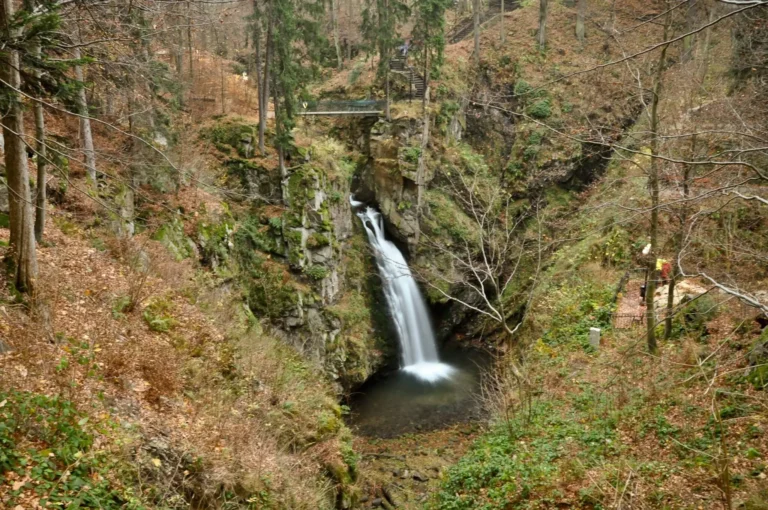
From Międzygórze via Wilczki Waterfall and the Fairy Tale Garden: Approximately 3 hours – this is the most beautiful route
Parking
At the Sanctuary: Limited number of spaces
Below the Sanctuary: Larger parking lot, from which you have to walk
Opening Hours
Church: Available for prayer every day
Visiting: No particular restrictions
Temperature and Weather
Summer: Approx. 12–15°C – cooler than at the foot
Winter: Approx. -5 to 0°C – possible snow and ice
Wind: Can be much stronger at the top
Pilgrimage Significance – Why This Place Is Important
Sanctuary of Our Lady of the Cause of Our Joy “Mary of the Snows”] is not just a tourist attraction – it is a place of deep pilgrimage and spiritual significance. For Catholics seeking graces and health, this is one of the important places in Poland.
Why Do People Pilgrimage?
Miraculous Healings: The history of miracles that have happened here inspires believers to hope
Personal Contact with Mary: Many people feel a special closeness to the Mother of God here.
Beauty of Nature: The landscape – mountains, forests, valley – itself has a healing effect on souls.
History: A story of faith that survived wars, a divided country, political oppression.