Long before the emergence of states, the demarcation of borders, and the construction of modern highways, Europe was crisscrossed by a network of powerful communication arteries. The most important of these, the legendary axis connecting the civilizations of the South with the barbarian North, was the Amber Route – a historical trade route, through which the “gold of the Baltic” flowed for centuries. This ancient route, leading from the Baltic coasts all the way to the Mediterranean Sea, is not just an abstract concept from history textbooks. It is a real road that had its key, strategic section running precisely through the Kłodzko Valley, forever changing its commercial significance and cultural importance.
As hosts of “Gołąbek”, fascinated by the deep historical roots of our land, we want to take you on a journey in the footsteps of this extraordinary route. We have created the ultimate compendium for you. This is the most complete guide we could have written. We will reveal to you the fascinating history of the ancient route, trace its exact course through the Kłodzko Valley, tell you about the modern revival of this idea, and suggest how today, thanks to the Amber Route cycling trail, you can touch this extraordinary historical education on your own wheels (or feet).
Gold of the North: What Was the Amber Route and Why Was It Created?
The history of the ancient route dates back to the Bronze Age, but its greatest flourishing occurred during the Roman Empire (1st-4th centuries AD). The Romans, and especially their wealthy elites, went crazy for amber. They considered it a magical, medicinal, and extremely decorative stone. It was more valuable than gold, and possessing amber jewelry or amulets was a marker of the highest status. However, this raw material occurred almost exclusively on the southern coasts of the Baltic Sea. To obtain it, long-distance, dangerous merchant expeditions were organized, which gave rise to a regular network of trade routes, collectively called the Amber Route.
From Rome to the Baltic: The Course of the Main Thread of the Route
The route was not a single, asphalt road. It was rather a communication corridor, with a main axis and numerous branches. The most important of these, the so-called “Kalisz route”, led from Aquileia on the Adriatic, through present-day Slovenia, Austria, the Czech Republic (through the Moravian Gate), and then entered Polish territory. And this is where the key role of our region comes in.
Moravian Gate and Międzylesie Pass – Key Gateways
After passing through the Moravian Gate, Roman caravans faced the mighty barrier of the Sudetes. The most convenient, lowest, and safest passage was precisely the Międzylesie Pass, separating the Śnieżnik Massif from the Bystrzyckie Mountains. It was through here, along the valley of the Nysa Kłodzka, that the main route of the Amber Route ran through the Kłodzko Valley. After crossing the pass, merchants headed north, through present-day Bystrzyca Kłodzka and Kłodzko, towards Wrocław, and from there further, through Kalisz, all the way to the mouth of the Vistula.
More Than Just Trade: Cultural and Civilizational Significance
The Amber Route was a prehistoric highway, through which not only goods flowed. It was along this road that the following reached the territories of “barbarian” Central Europe:
Roman technologies and goods: Coins, ceramic vessels (terra sigillata), glass goblets, weapons.
New ideas and cultural patterns: Lifestyle, fashion, and in later periods also the first ideas of Christianity.
Information and knowledge: Thanks to merchants, the Romans possessed surprisingly accurate knowledge of the geography and tribes inhabiting the territories of present-day Poland.
In the other direction, southwards, not only amber traveled, but also hides, furs, honey, and probably also slaves. The commercial significance and civilizational impact of this route on the development of the tribes inhabiting these territories at the time was absolutely fundamental.
Traces of the Past: Archaeological Sites
Evidence of the route’s course is not just speculation. Archaeologists have been discovering numerous artifacts in the Kłodzko Land and its vicinity for years, confirming intense contacts with the Roman Empire. Roman coins (denarii), fragments of jewelry and vessels are found. These valuable finds can be admired today at the Museum of the Kłodzko Land in Kłodzko, which in its collections has evidence of the ancient history of the region.
On Two Wheels Through History: Amber Route Cycling Trail (EuroVelo 9)
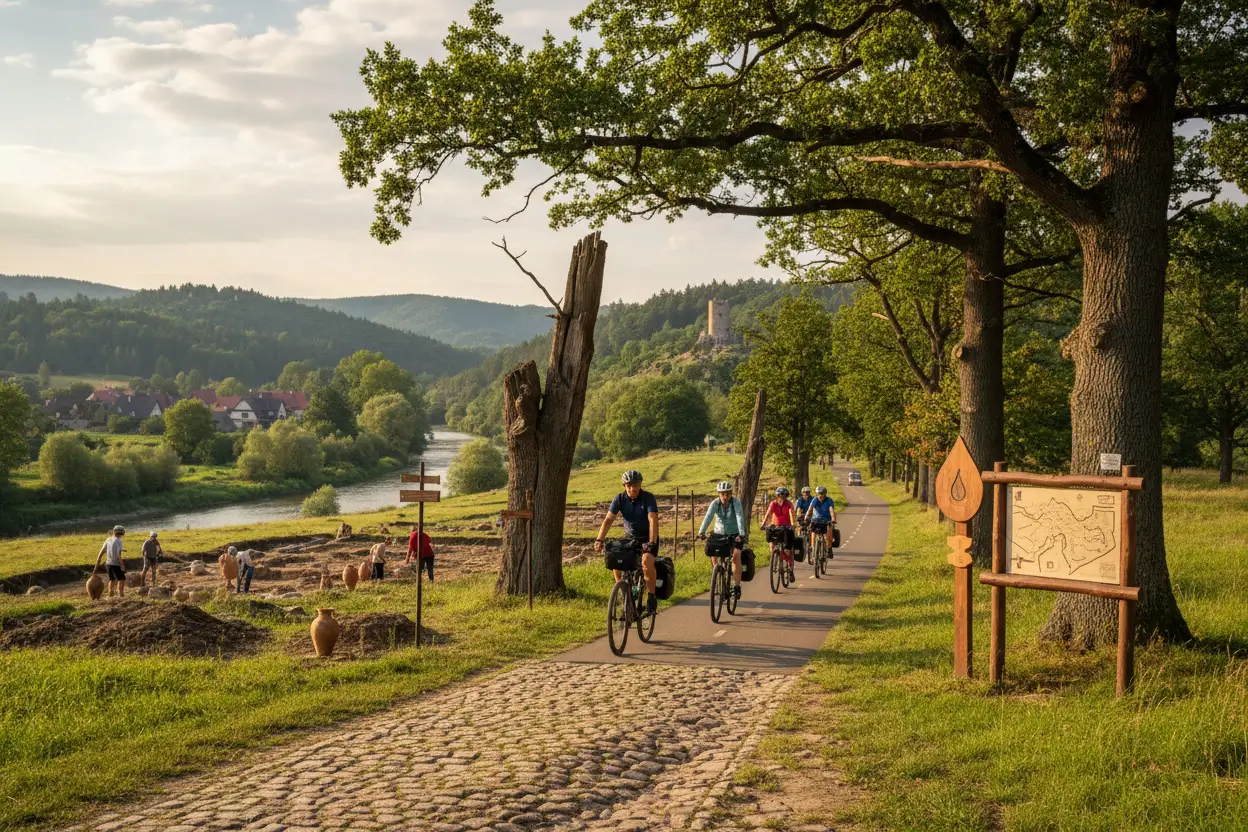
The idea of modern revival of the route has today taken on a fantastic tourist form. An international Amber Route cycling trail, part of the European EuroVelo network (route No. 9), runs through Poland, including the heart of the Kłodzko Valley.
Course of the Route through the Kłodzko Land: The EV9 route enters Poland from the Czech Republic precisely at the Międzylesie Pass – exactly where Roman caravans entered thousands of years ago. It then leads through Międzylesie, Bystrzyca Kłodzka, Polanica-Zdrój, Szczytna, and further north.
Most Beautiful Sections: The Kłodzko section is extremely picturesque. It leads both along dedicated cycle paths and along quiet local roads. It’s a fantastic way to actively historical education – traveling by bike, you can see with your own eyes the landscape that ancient merchants traversed and visit the cities that grew up on this historic route.
“Gołąbek” – Your Base for Exploring the Historical Route
Discovering the heritage of the Amber Route is a fascinating adventure that combines a passion for history, cycling tourism, and a love for beautiful landscapes. “Gołąbek” in Stronie Śląskie is an ideal base for this.
Location: We are located in the immediate vicinity of the historical route and the modern EV9 cycling route. It is an ideal starting point or stopover on a longer route.
Infrastructure for cyclists: We offer a safe place to store bicycles and basic tools.
Knowledge and inspiration: We will be happy to help you plan a cycling trip in the footsteps of the Romans, point out the most interesting sections, and tell you about historical curiosities that will make your trip take on a completely new dimension.
Traveling through the Kłodzko Valley, remember that the roads you are traveling on have a history much older than it seems. This is a land marked by the echo of Roman chariot wheels and the clatter of horses’ hooves carrying a priceless cargo – the gold of the North.